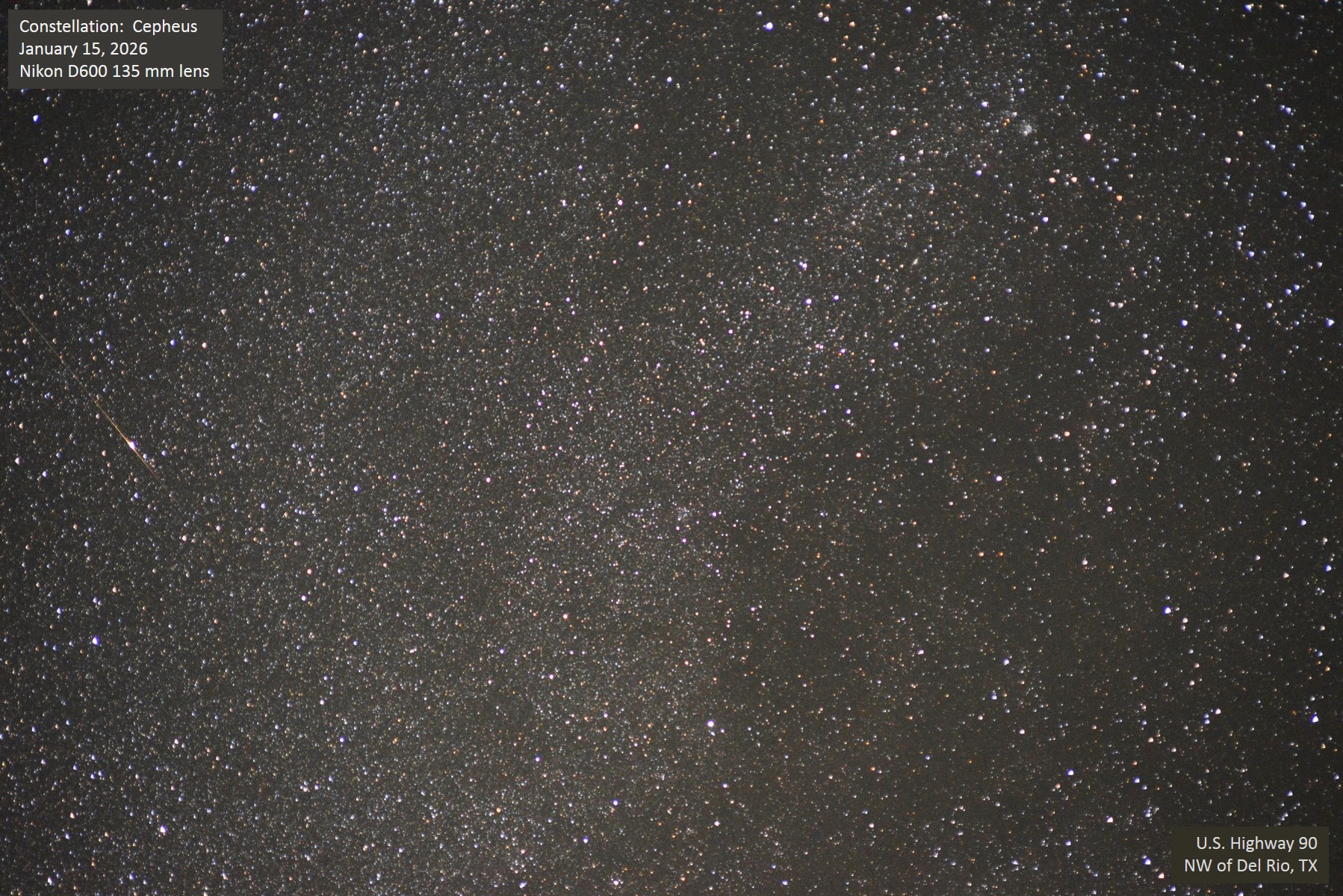
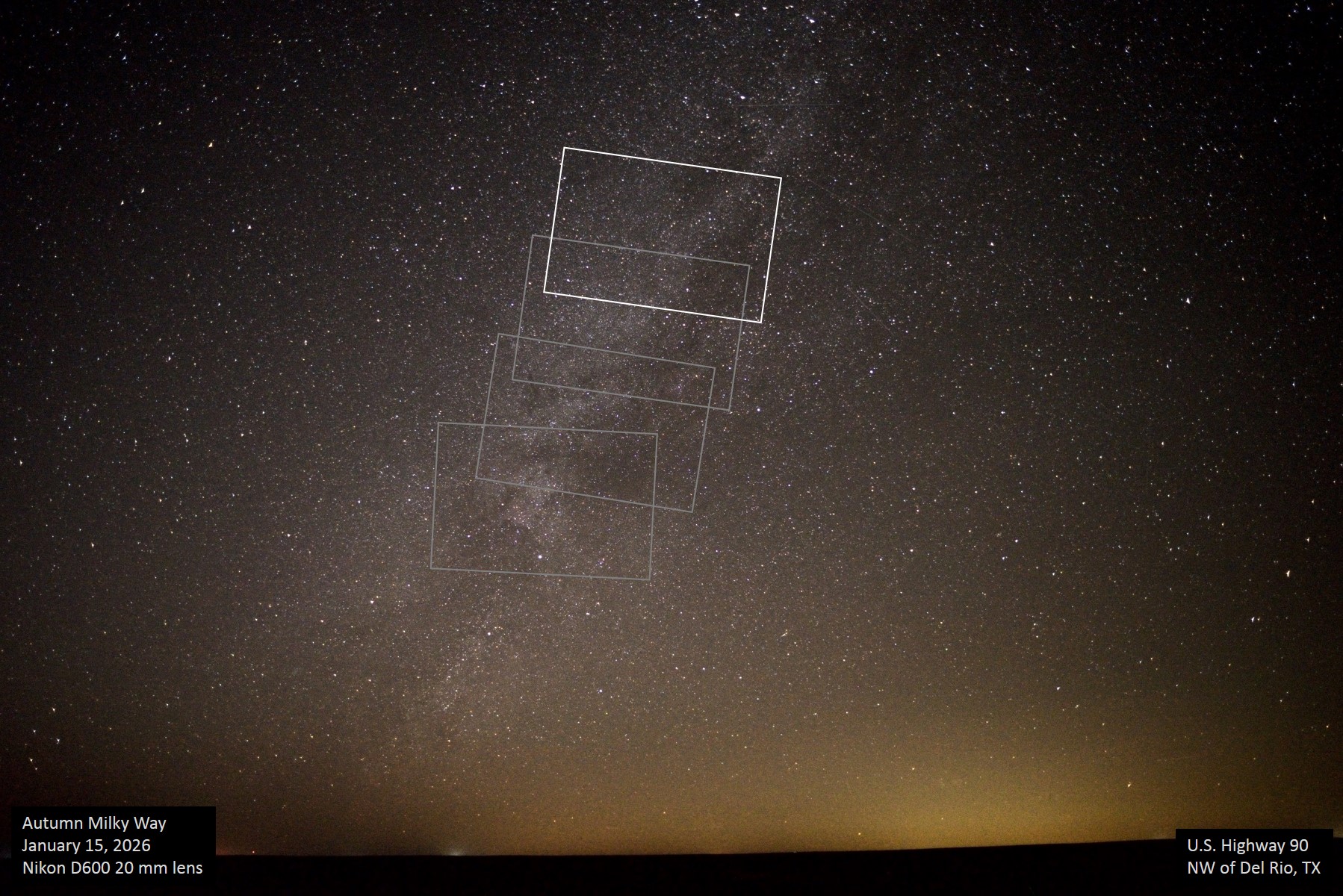
The image at left was taken with a 135 mm telephoto lens and corresponds to the area within the white rectangle in the image above. The picture above shows the Milky Way from Cygnus along the horizon slanting up to the right to the constellation Cassiopeia at the top edge. Along the right edge of the above image, Polaris and the little dipper arcing downward are shown.
This image continues up the spine of the Milky Way from the image of Lacerta, in the direction of Cassiopeia. This area is dominated by the bright Messier cluster M52 just over the boundary in Cassiopeia, but there are four open clusters we labeled in southern Cepheus. As in our other images of the northern Milky Way, this exposure is long enough to highlight the many dark clouds of dust and gas that obscure the more distant stars, most notabley in the area of Cepheus and western Cassiopeia. I also caught a nice meteor on the left side of the image, with a little explosion towards the end of its track (I checked to see that it is not a star) One object that most amateurs will not have observed because of its obscurity is NGC 7419. Its Wikipedia entry shows that this cluster is very unusual owing to the presence of multiple red giant stars that dominate the cluster. Based on the sources I have for it, the cluster's magnitude is listed at +13, and yet it shows up on my image?!? Unannotated image.