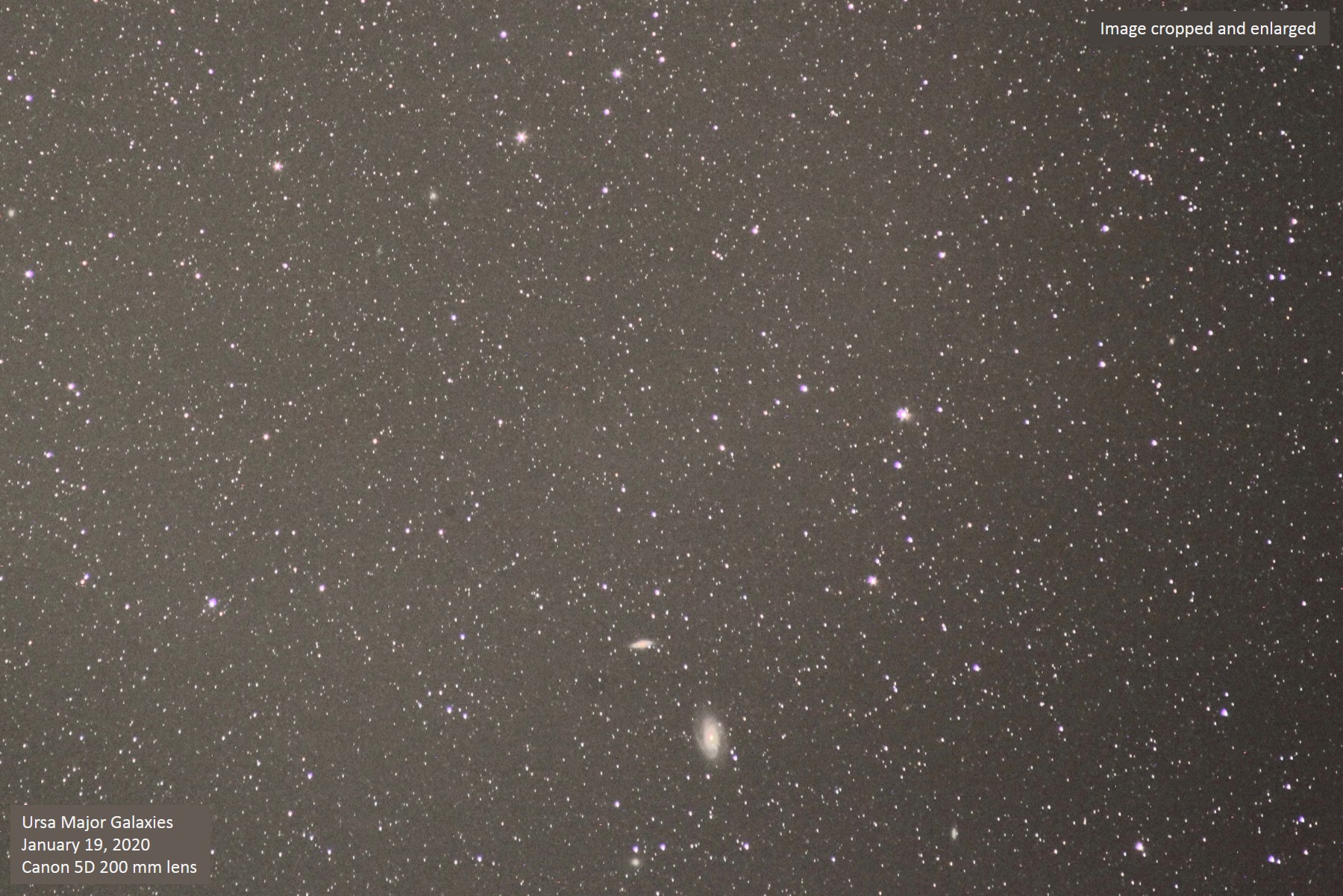
We can actually see a hint of spiral arms in
M81 as well as the characteristic shape that
M82 presents. The two companion galaxies for
the Messier pair also show up very nicely at
the bottom of the image. These galaxies, NGC
2976 and 3077, would both be better known if
they weren't so close to the Messier pair.
NGC 2985 is also an easy target for small or
medium sized telescopes because it is bright
and not too small. NGC 3027 exhibits a lower
surface brightness, so even though it is not
small, more aperture would be required to be
able to see it well. NGC 3065 and 3066 are a
close pair of very small but bright galaxies
that will look like fuzzy stars unless high
magnification is used. Finally, at the left
edge of the image, NGC 3147 is of a similar
size and brightness to NGC 2985, so it makes
a good target for small to medium telescopes
so long as you have reasonably dark skies.
List of Objects:
One interesting thing that comes out of the
descriptions on TheSkyLive™ of NGC 3065 and
NGC 3066 is that despite the fact that they
look very similar on my image, the first is
a lenticular galaxy while the second one is
an intermediate spiral, so their structures
are completely different; you would only be
able to discern the difference with a high
power eyepiece.
This image of a galaxy field in northwestern Ursa Major was taken with my Canon 5D (modified) camera and a 200 mm lens from a dark location on the Pamlico Sound in North Carolina. The image was cropped down and enlarged, so the scale of the galaxies does not correspond to what an unedited 200 mm lens with a full frame camera would show. Based on the amount of enlargement, the equivalent lens size would be 285 mm. Unannotated image.