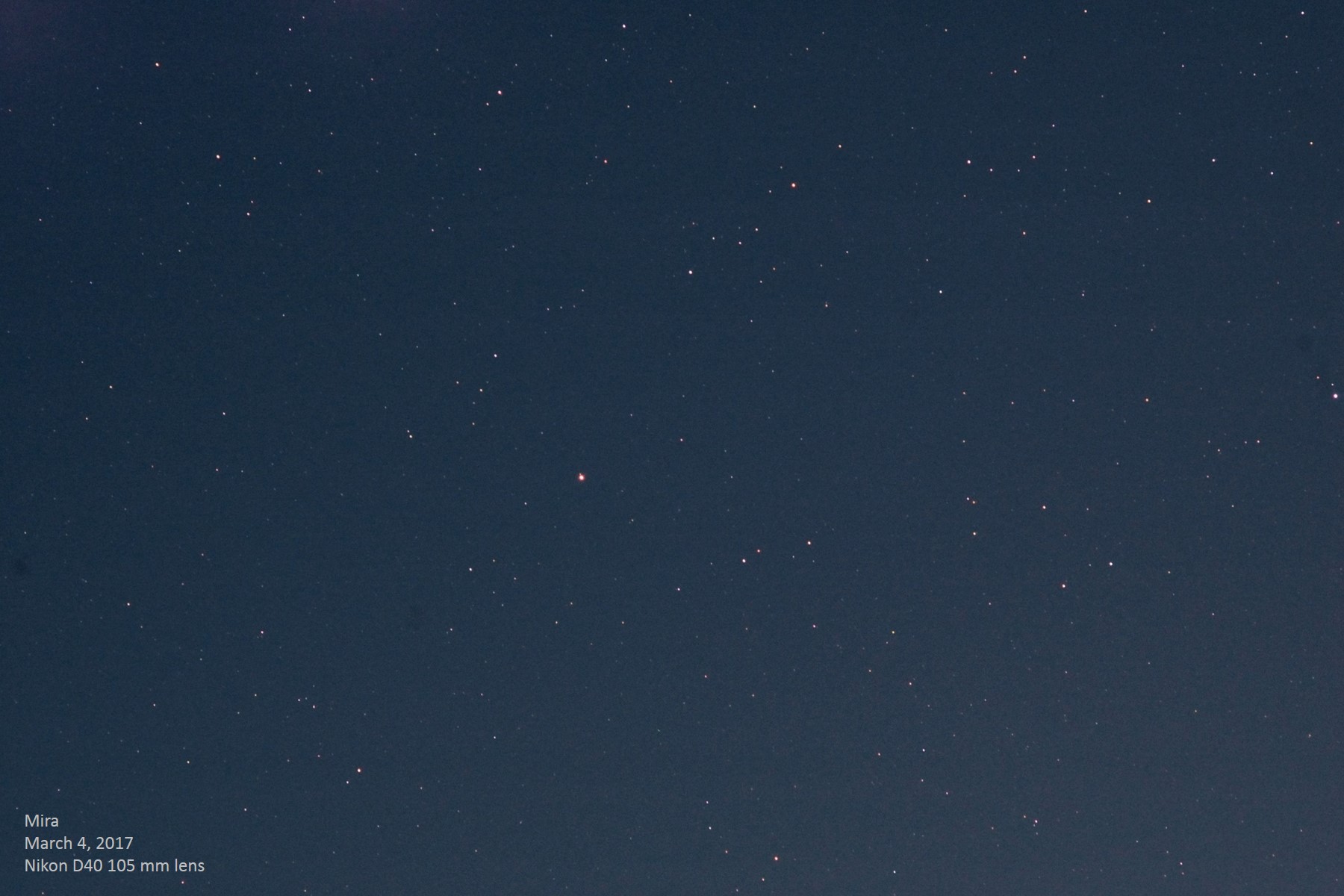
The great variable star ο Ceti, known by its common name of Mira ("the wonderful"), was near its maximum in early 2017. According to several online sources, Mira achieved maximum in late February 2017 at around magnitude 3.5, so our image here is likely still catching Mira very close to its maximum. Unannotated image.
This image was taken with a Nikon D40 and a 105 mm lens, which equates to a camera with a full-frame sensor using a 157 mm lens. My camera was positioned to be horizontal with respect to the western horizon, so north is pointed to the upper right. Alrischa, the α star of Pisces, is at the right edge of the frame in the center.
Alrischa is magnitude 3.82, and even though image brightness falls off at the edge of a picture, it certainly seems as if Mira is a good bit brighter than Alrischa. This light curve on Wikipedia shows the maximum on the right side of the graph, from which we read that the average estimate of its brightness was about 3.5 during late February 2017.

Careful examination of the image shows that there is a very faint reddish star just off of the upper left of Mira. This is HD 14411 and has a magnitude of 9.28, giving one the appearance of the double star γ Ceti. I may put this on my observing list because their separation of 2'03" suggests a wide "planet and moon" look at low power.
Mira's spectral classification is M5e-M9e, which indicates a red giant or dwarf star, ranging from cool to very cool, exhibiting emission lines in its spectrum. Its period varies somewhat but is generally around 11 months.