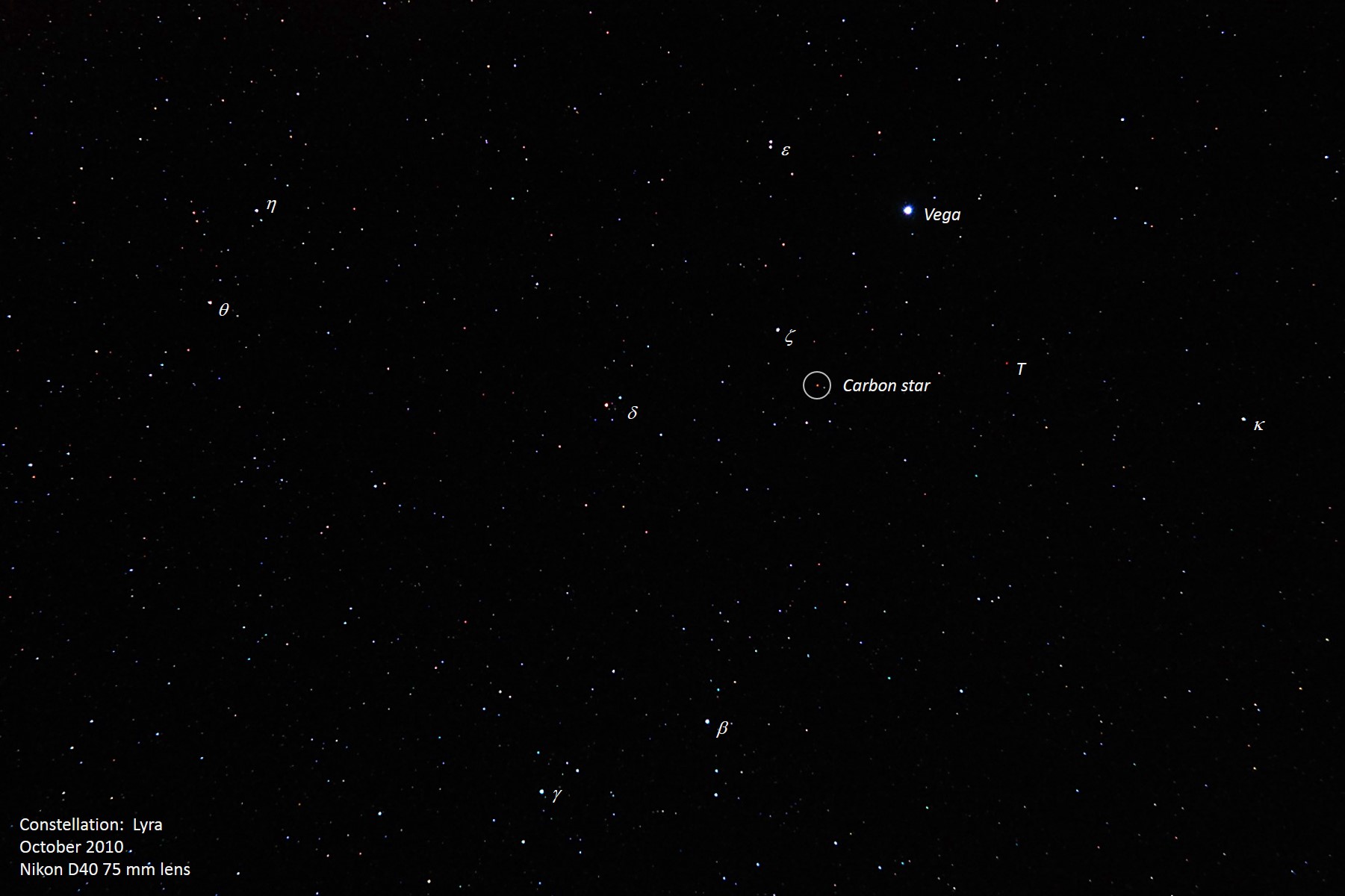
The constellation Lyra is dominated by Vega, the fifth brightest star in the sky, however it also includes numerous other interesting objects. One of the most famous is M57, the Ring Nebula; this object is not marked on the image but is located about half-way between beta and gamma Lyrae. The star near the center top of the image, marked as epsilon, is the famous "double-double" of Lyra ~ it is an easily resolvable double when viewed in binoculars, but with a telescope, each component resolves into a tight pair of stars. Oriented at right angles to each other, they are striking in a telescope.
Other double stars in Lyra, suitable for viewing in binoculars or small telescopes, include delta Lyrae, beta Lyrae, and zeta Lyrae. Delta is more like a pair of separate stars than a double star but nevertheless they share the same designation of delta. They are slightly over 10' apart which is about 1/3 of a Moon diameter. Zeta is the 3rd star making a triangle with Vega and epsilon; it presents as two stars of unequal brightness with 44" between them. It should be separatable using 7x binoculars if you can hold them steadily. The star at the bottom right corner of Lyra is known as beta; it consists of two unequal stars with a separation of 46", which should also be suitable for 7x binoculars, except that the two stars are more unequal than zeta. Binoculars with 10x have a better chance at splitting beta.
Finally, the Lyre also hosts two examples of the class of object known as carbon stars. These are stars with extremely sooty atmospheres that tend to absorb all the light from star except for the deep red end of the spectrum, making them appear extremely red. The famous one is known as T, and can be found southwest of Vega. T Lyrae is quite faint, so it requires a small telescope to find. I have not been able to find it with binoculars, but my eyesight isn't the best, so give it a try yourself! Lastly, we have another carbon star to the east of T, which I circled and which has the designation HK Lyrae; it is almost the same mag- nitude as T but does not appear quite as red, to me anyway.