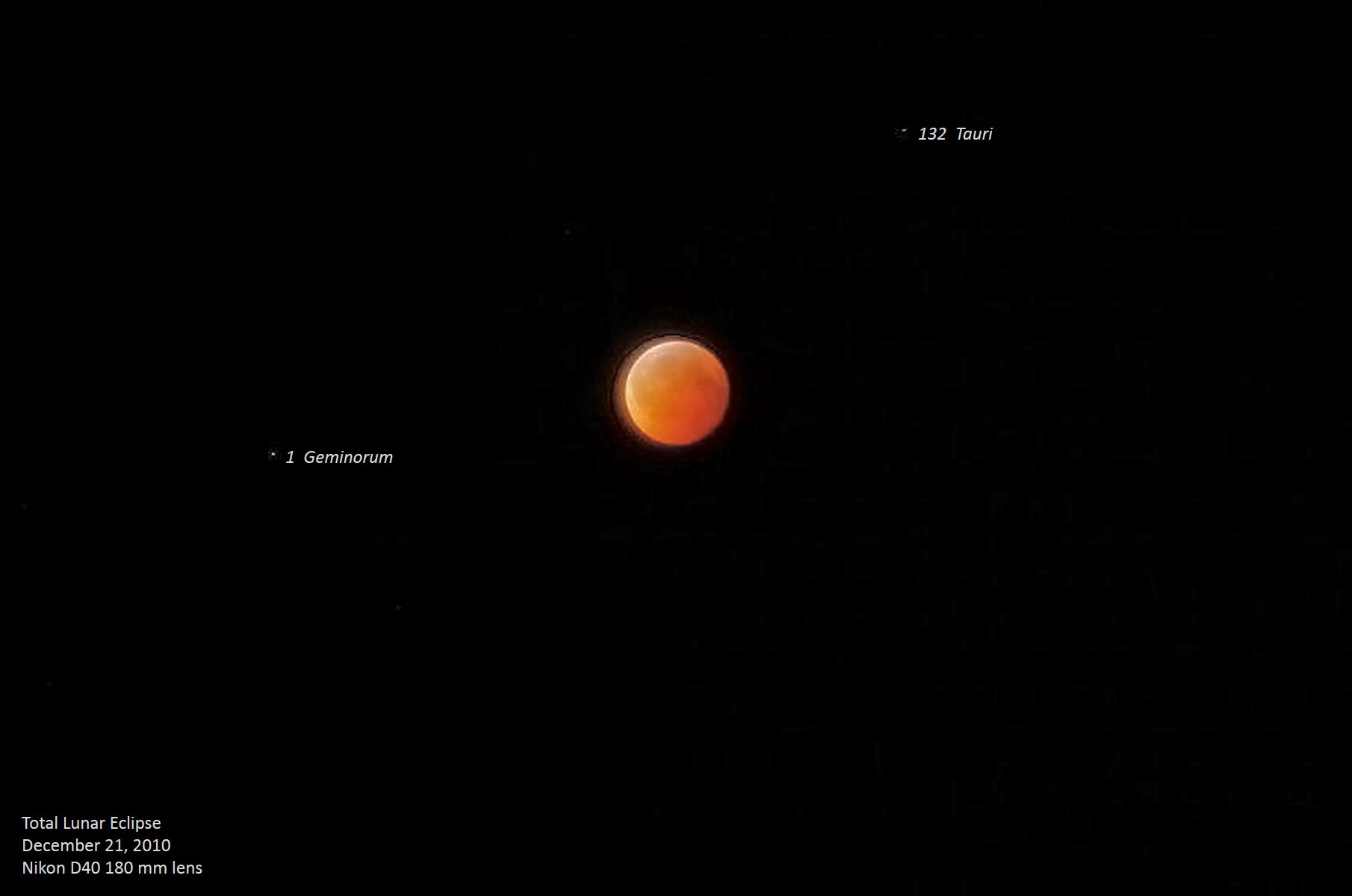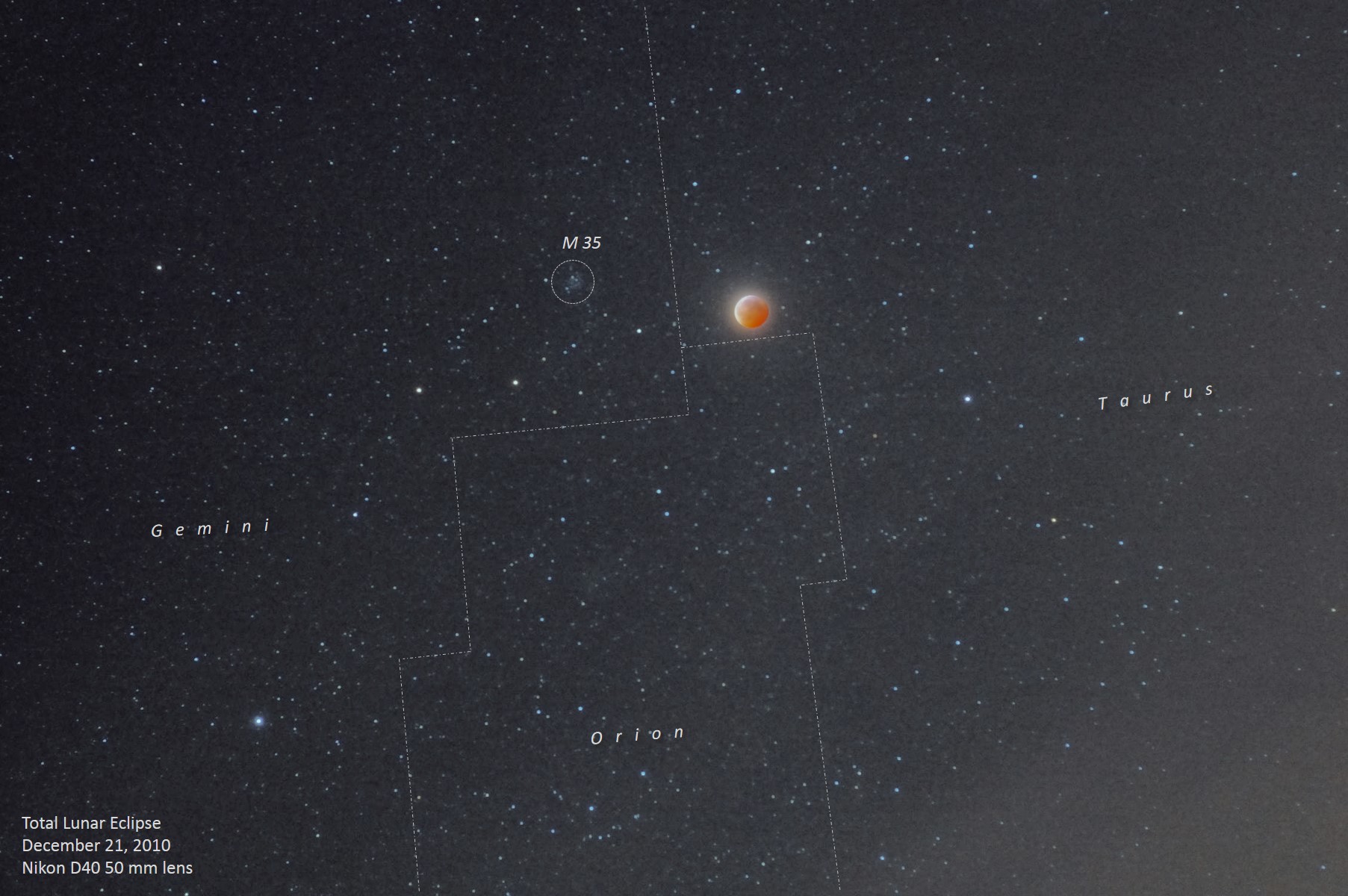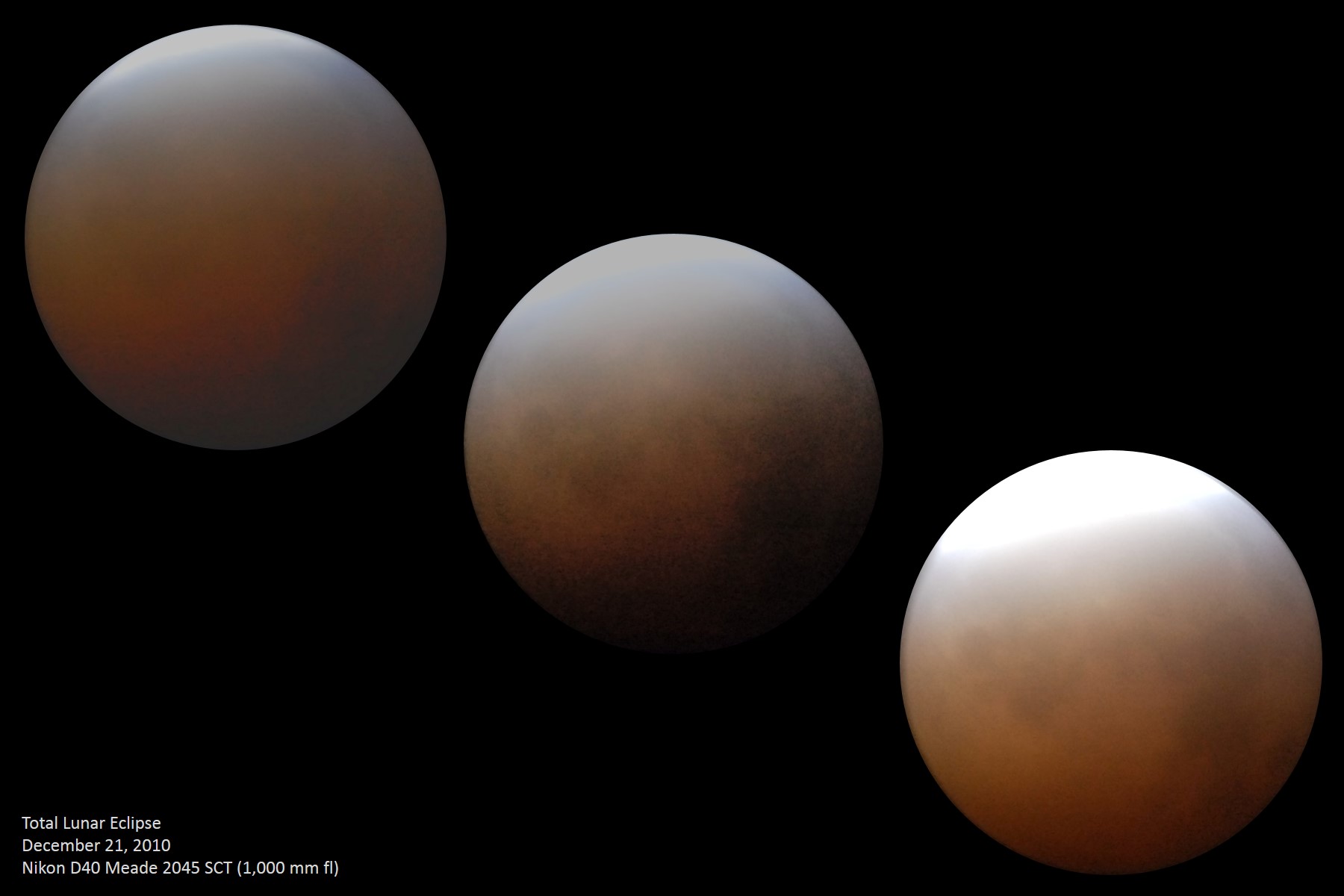
A total lunar eclipse was visible from all of North America on the night of December 20 to December 21, a rare event in that the eclipse occurred exactly on the night of the winter solstice. I don't recall from where I viewed the eclipse, but it was proba- bly from King George County, because I would not have been able to get the wide angle picture showing the eclipse in a dark sky from Fredericksburg. I used my Nikon D40 digital SLR along with a variety of lenses: a 50 mm lens for the wide angle picture, a 180mm lens for the moderate zoom level picture, and finally a Meade 2045 4" Schmidt Cassegrain Telescope with a 1,000 mm focal length for the enlarged views.
This eclipse is the first of a pair in the current eclipse season. After this lunar event, two weeks later on January 4, 2011, a partial solar eclipse visible from the northern Africa, Europe, and west Asia occurred. Because our lunar eclipse is total, it is a "central" eclipse, meaning not partial or penumbral. The moon has not yet passed descending node as it approaches Earth's shadow, so it occurs in the northern part of the umbra. This manifests itself in my pictures as you can see the bright white portion of the Moon is the part closest to the edge of the umbra, and therefore brighter than the other side which is closer to the center of the umbra.
Since the eclipse occurs on the winter solstice, it should not be surprising that the Moon is positioned near the summer sol- stice point, where Gemini and Taurus meet. We see the Moon in its eclipse location getting close to the large open cluster M35 in Gemini. Viewing the Moon at this event was a neck-craning experience since it was located as close to the zenith as its possible for the Moon to be LOL!
You definitely want to click on some of those links to see better pictures of this event than mine! I must have been having difficulty using my DSLR with the telescope to get pictures, because my images of previous lunar eclipses with film, and my later ones with DSLR's, are better. I could also have been having difficulty getting good focus because of the inconvenient geometry of my setup being pointed directly overhead.