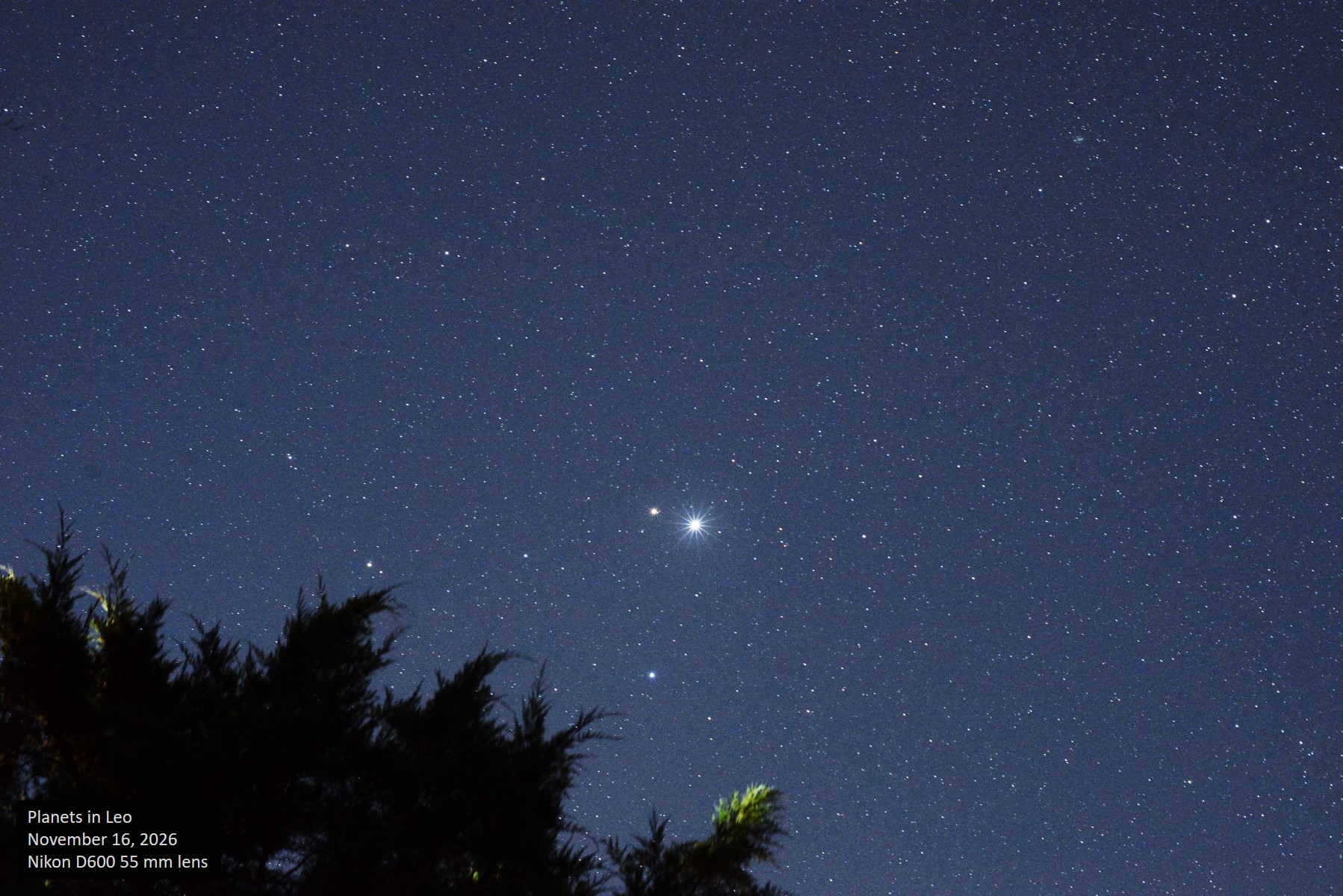
Jupiter and Mars are finally at their closest point during this period of their conjunction. Mars is magnitude +0.70 and Jupiter is magnitude -2.16, with a separation of 1°11'54" between them. The conjunction is in ecliptic longitude, which is based on the position of the ecliptic instead of the celestial equator. Unannotated image.
Mars and Jupiter undergo conjunctions at a fre- quency of a little less than one conjunction in every two years. Usually, during these conjunc- tions, Mars is much dimmer than Jupiter, but on this occasion, even though Jupiter outshines it considerably, Mars is brighter than it normally is at these conjunctions. Here is a list of the brighter conjunctions during the last 50 years:
| Date | Mars Mag | Jup Mag | Constellation |
| Feb 27, 1980 | -1.21 | -2.52 | Leo |
| Aug 08, 1982 | +0.64 | -2.00 | Virgo |
| Oct 13, 1984 | +0.38 | -2.18 | Sagittarius |
| Dec 18, 1986 | +0.40 | -2.40 | Aquarius |
| Mar 11, 1989 | +1.12 | -2.25 | Taurus |
| Jun 14, 1991 | +1.69 | -1.89 | Cancer |
| . . |
|||
| Oct 17, 2015 | +1.75 | -1.80 | Leo |
| Jan 06, 2018 | +1.43 | -1.88 | Libra |
| Mar 20, 2020 | +0.91 | -2.11 | Sagittarius |
| May 29, 2022 | +0.69 | -2.29 | Pisces |
| Aug 14, 2024 | +0.84 | -2.23 | Taurus |
| Nov 16, 2026 | +0.70 | -2.16 | Leo |
Mars' magnitude depends on two factors: one is how near Mars is to opposition and the other is how near Mars is to its perihelion. We can see that even when Mars is rather far from the time of its opposition, such as Dec 18 1986, Mars is still quite bright because it is on the perihel- ion side of its orbit.