Mercury is at the most observable position in a very long but low evening apparition, however it
is still barely observable. The ecliptic makes a low angle with the horizon at this
time of year, and to make matters worse, Mercury is well below the ecliptic at this point,
so its visibility is even more restricted. The Moon is almost three days old, with a
phase angle of 11%.
Unannotated image, Zoomed-in View.
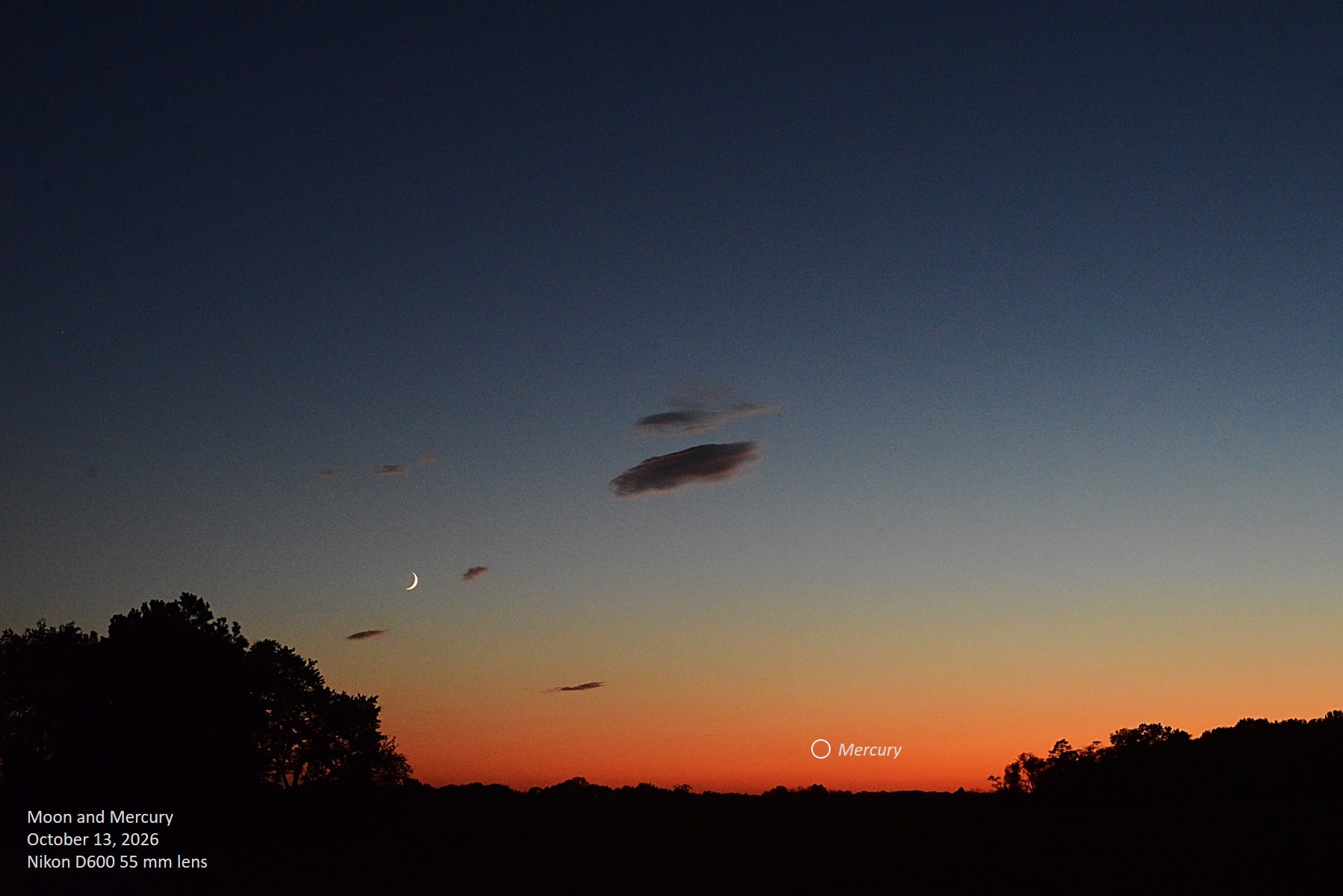
Although northern hemisphere observers have a difficult time seeing Mercury during fall evening apparitions such as this, observers in the southern hemisphere are being treat- ed to an excellent show. Mercury's position is almost vertically above the western hor- izon, so the elongation of 25° from the Sun translates almost completely into elevation above the horizon.
At the time I took the picture at left, the Sun was about 8° below the horizon; Mercury is barely above the horizon at our latitude of 38°12' North. How would the scene appear for observers at a latitude of 35° South if the Sun was 8° below their horizon?
Hover over the below image to see the angle that the Moon and Mercury make if we trans- port ourselves to Buenos Aires. The horizon of our base image is the horizon of the new rotated image so the rotated image presents the Moon and Mercury at close to the height above the horizon as would be seen from 35° South latitude.
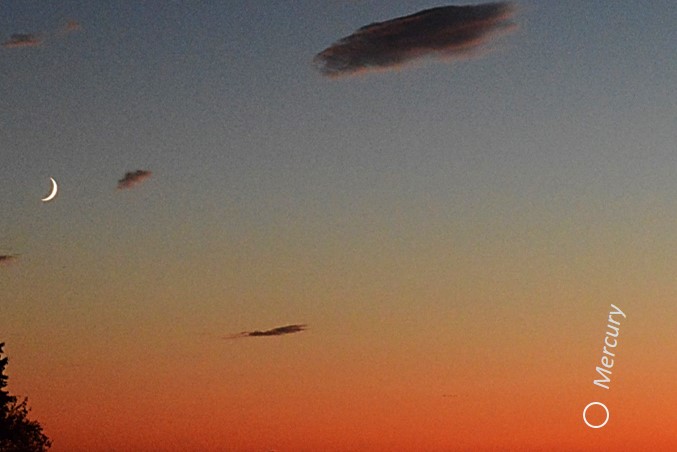
Usage note: place your mouse over the thumb- nail but keep it still; any movement of the mouse will result in the image returning to the original position. You can also follow the rotated image with the mouse to keep it in place.