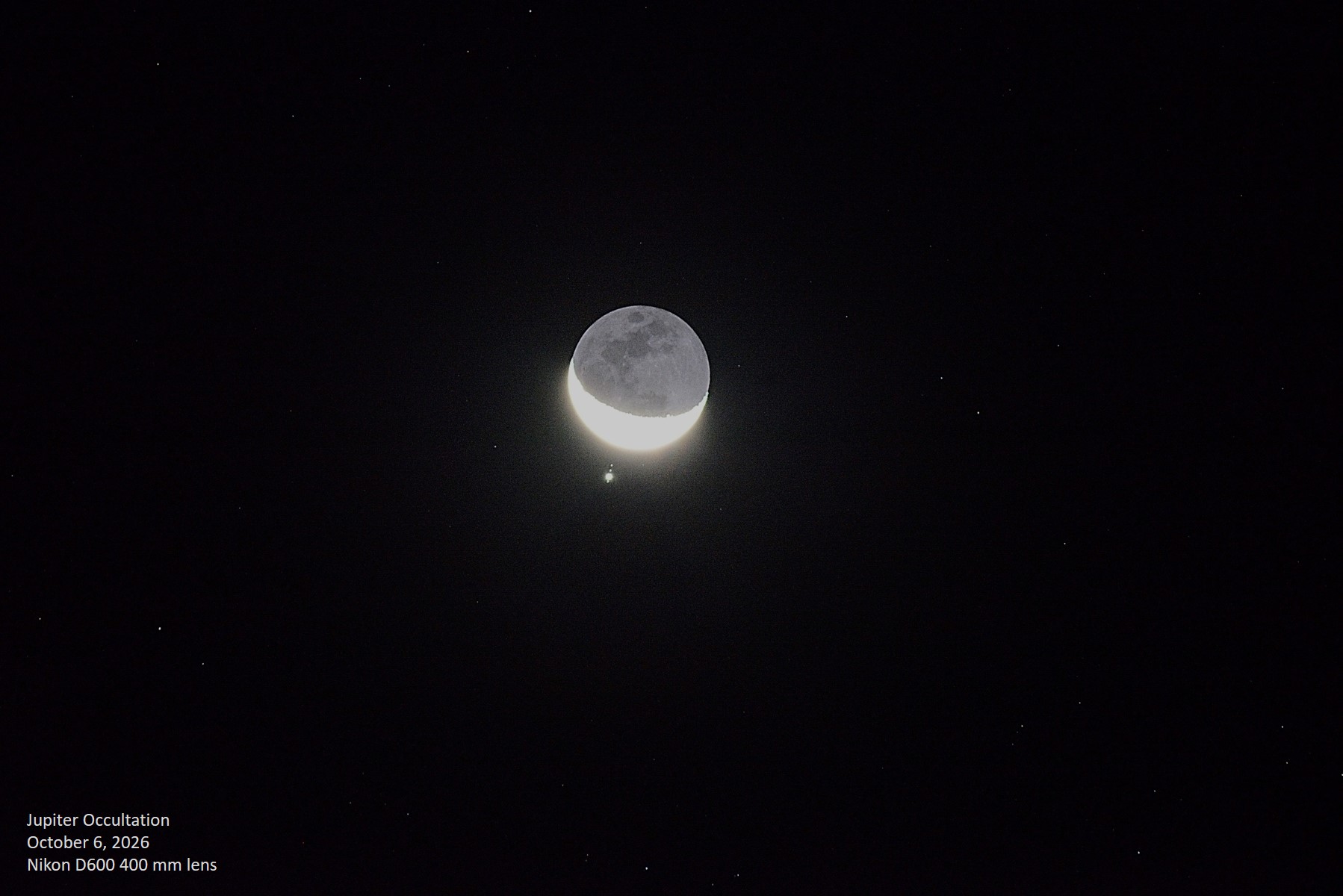
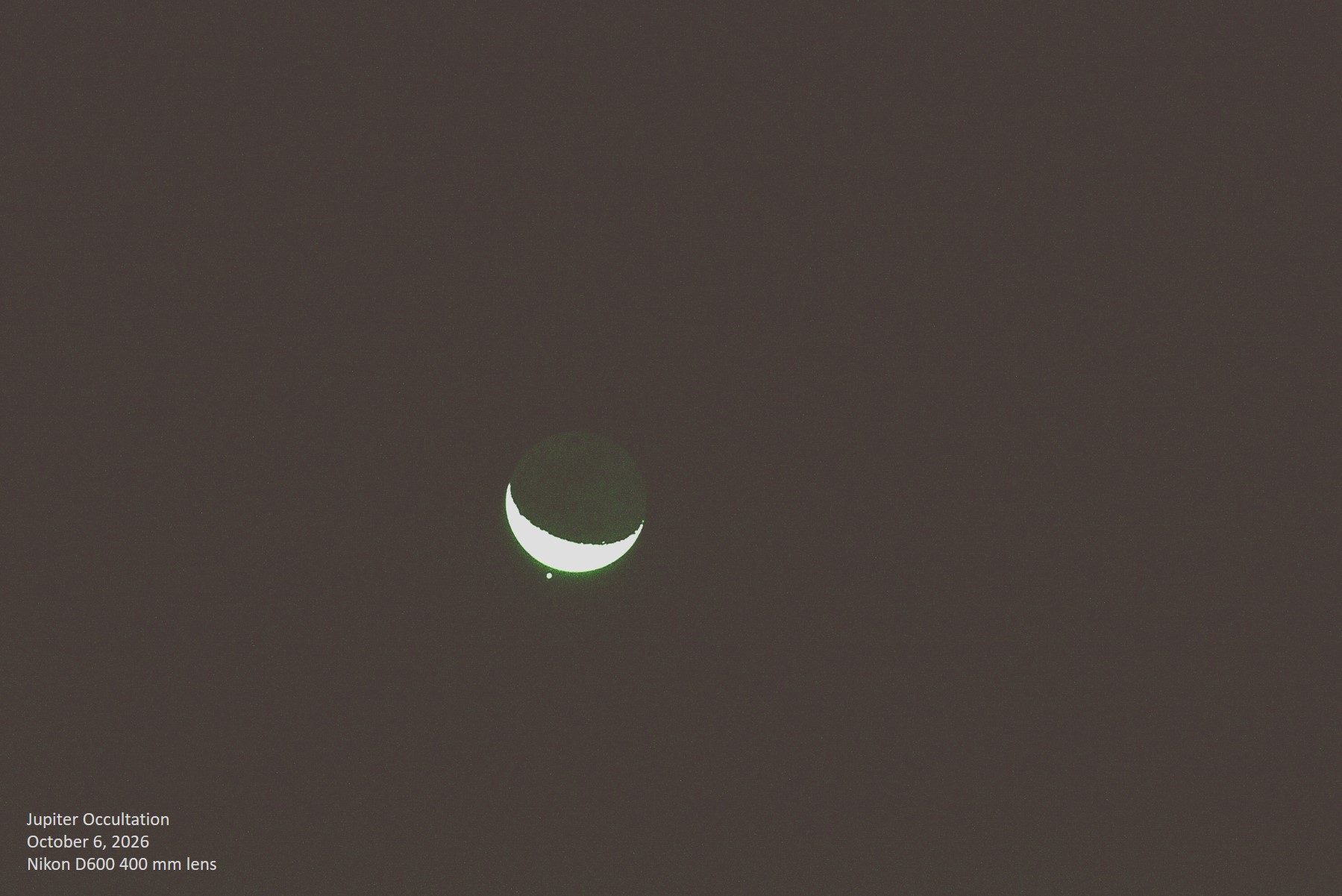
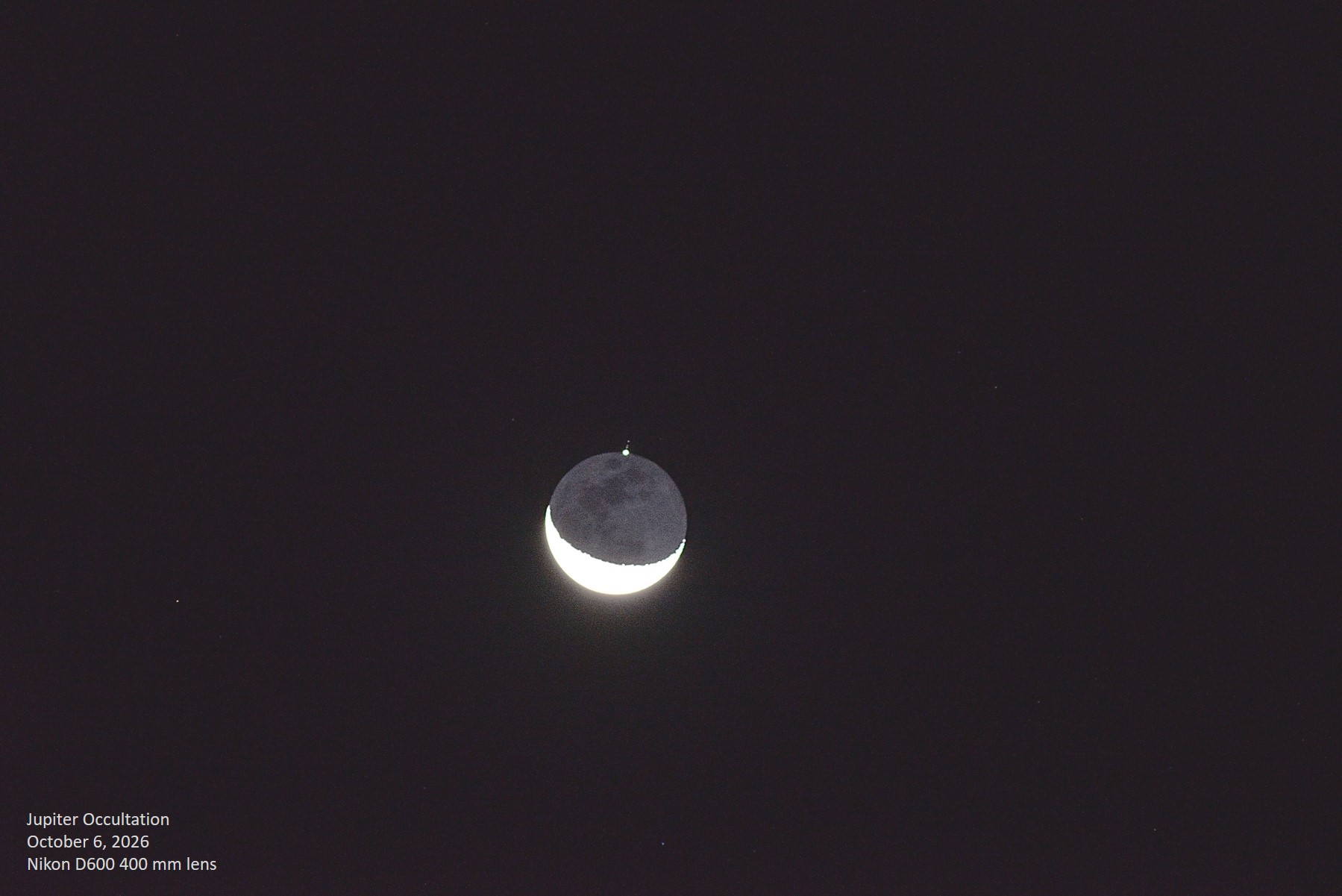
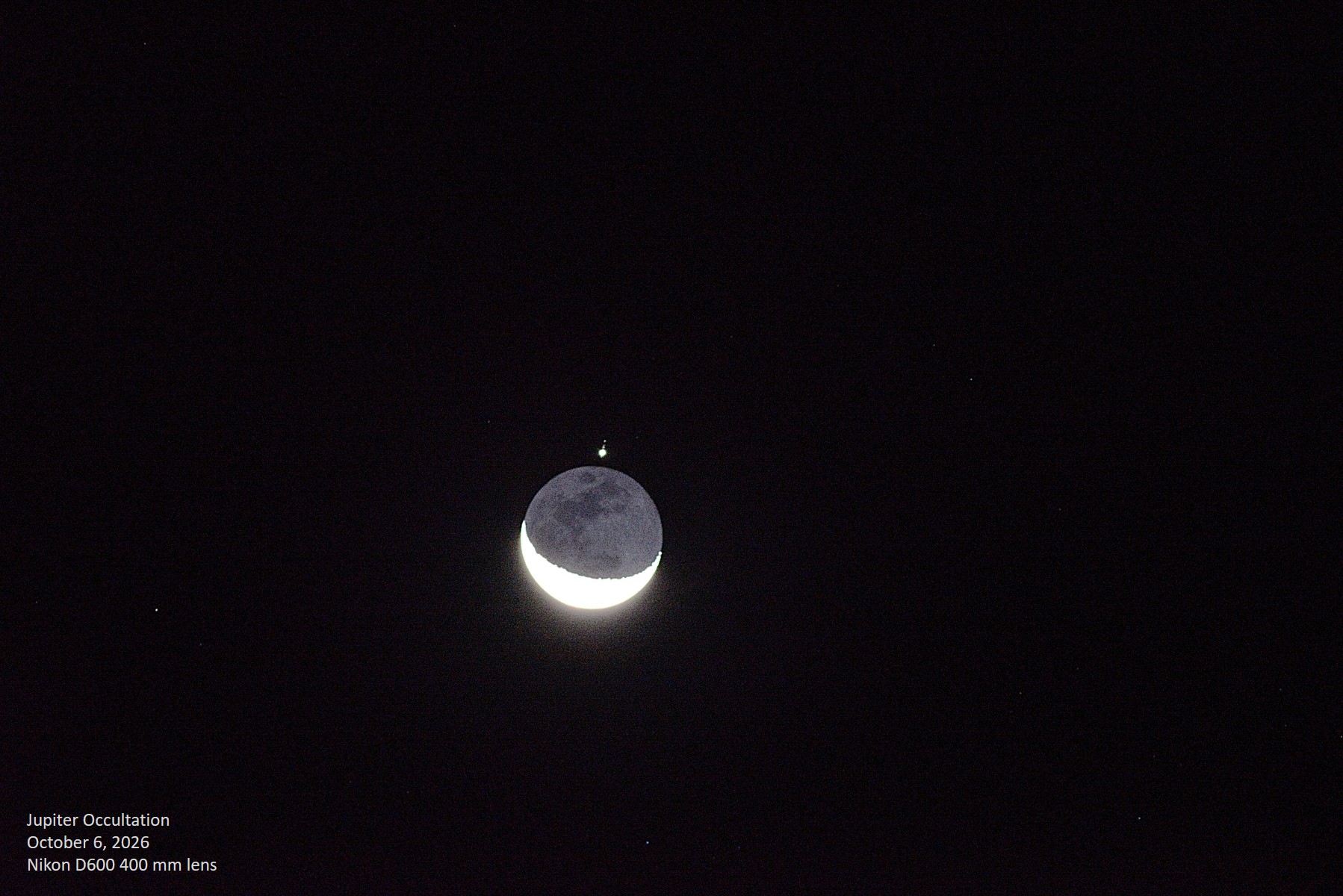
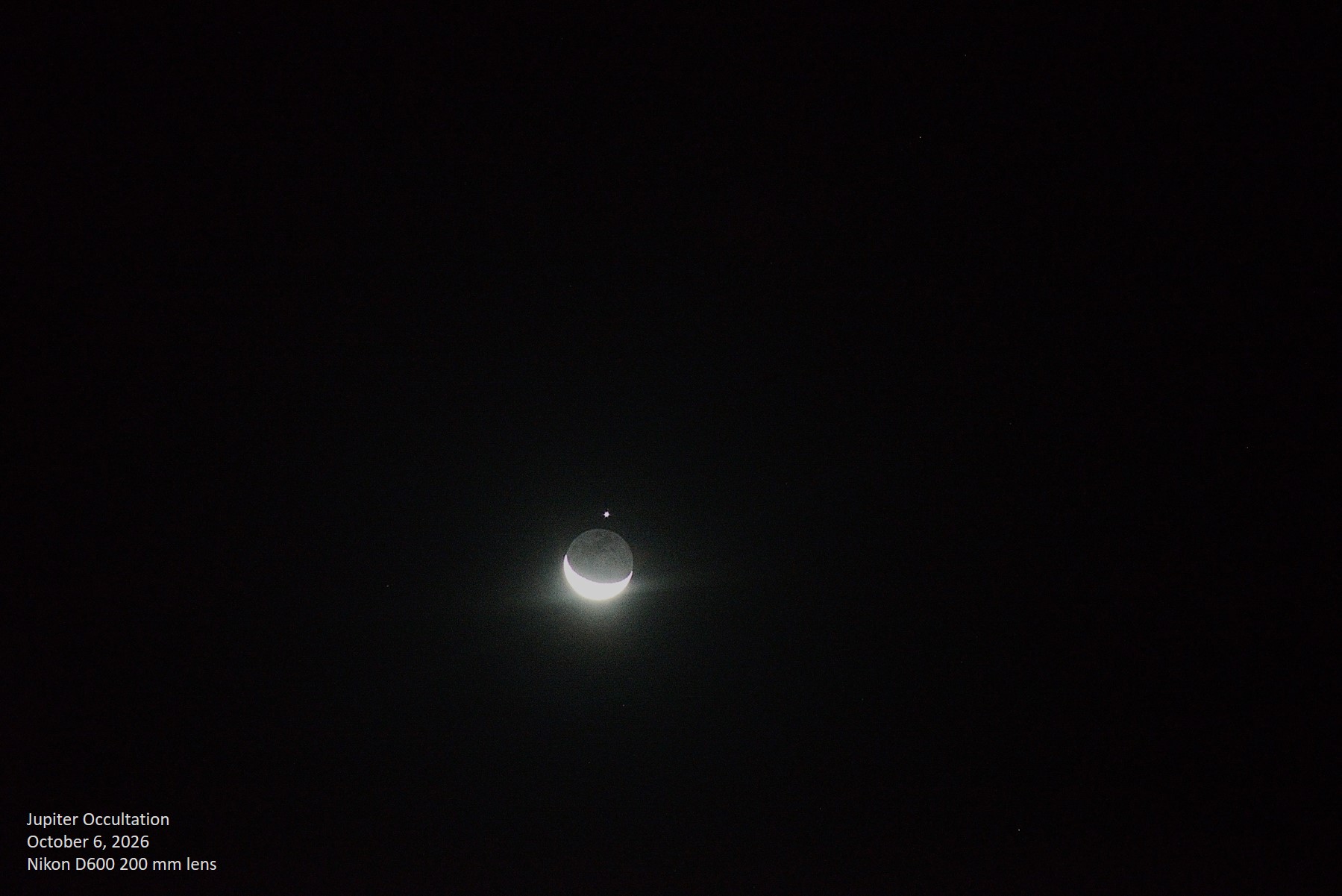
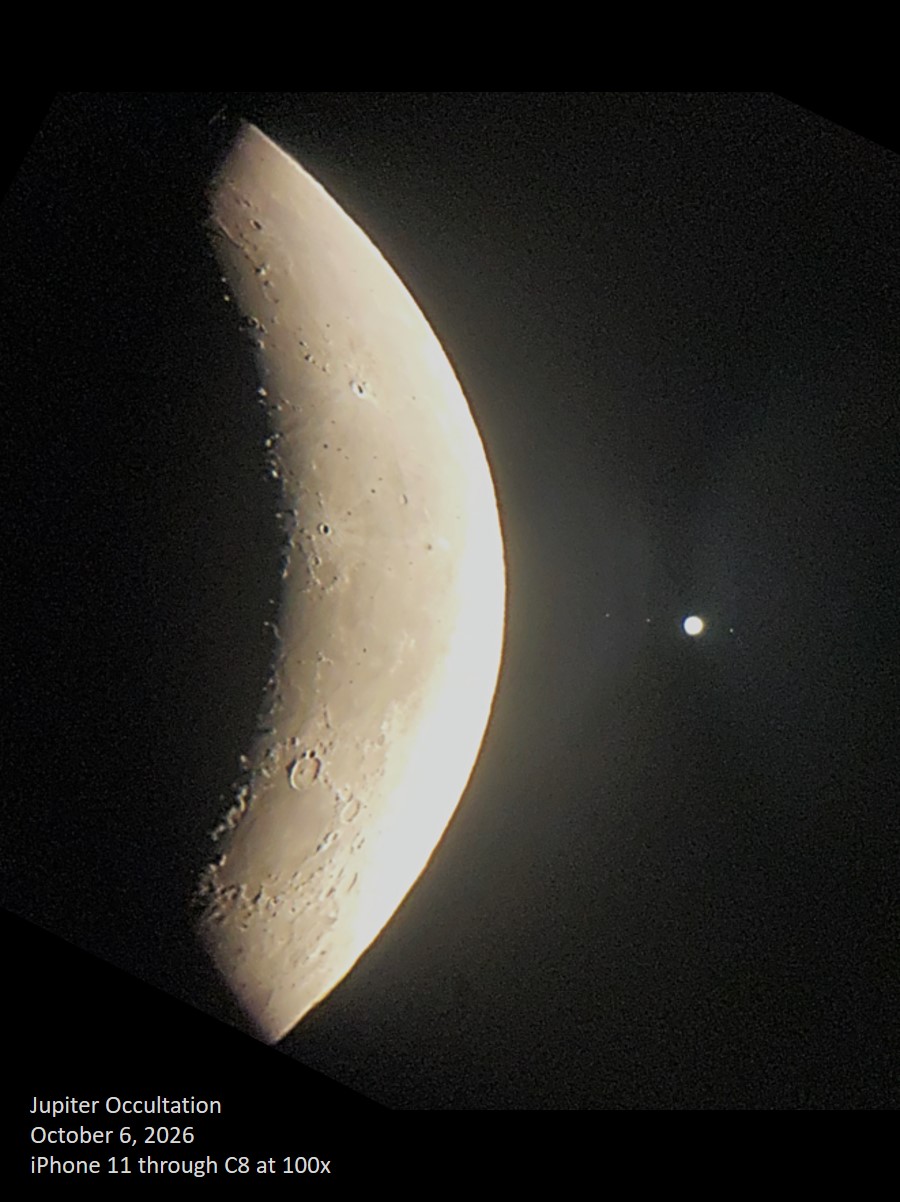
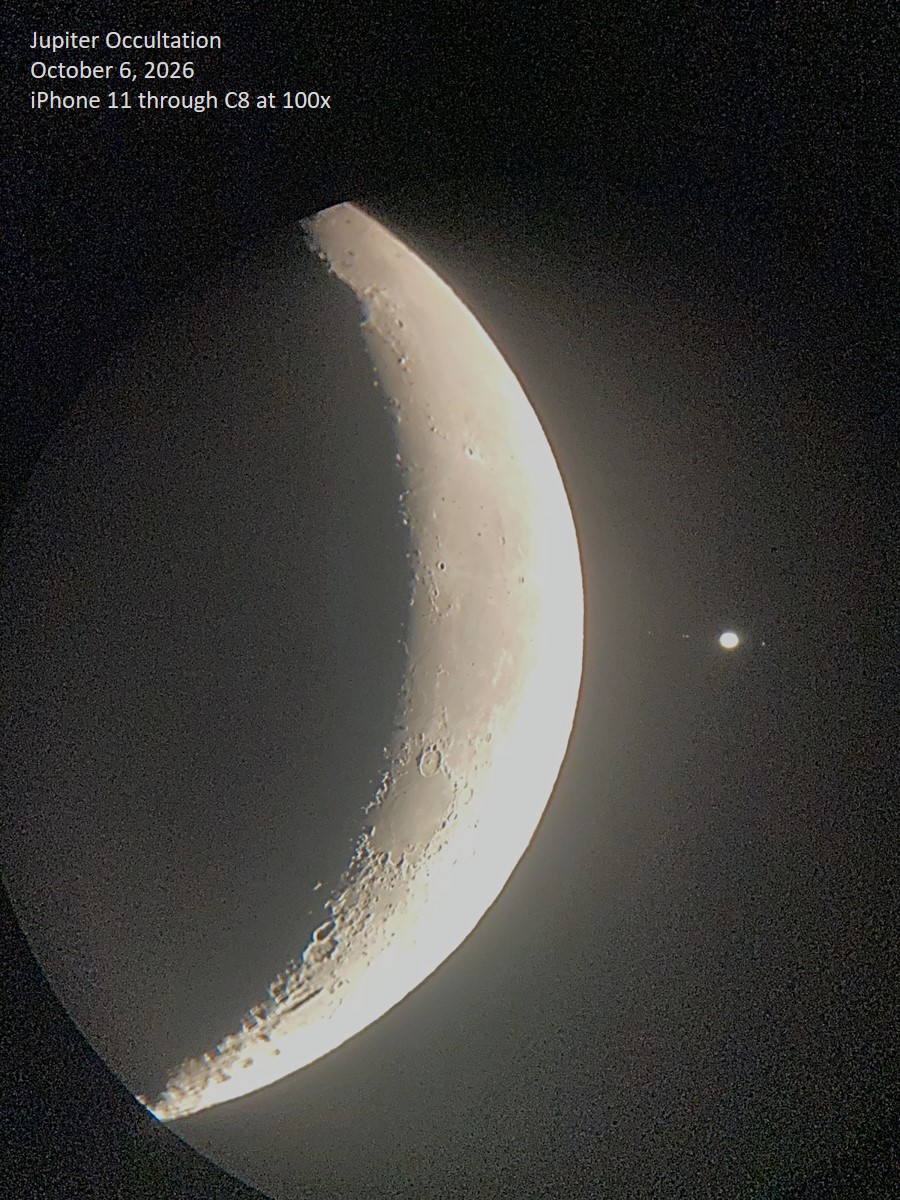
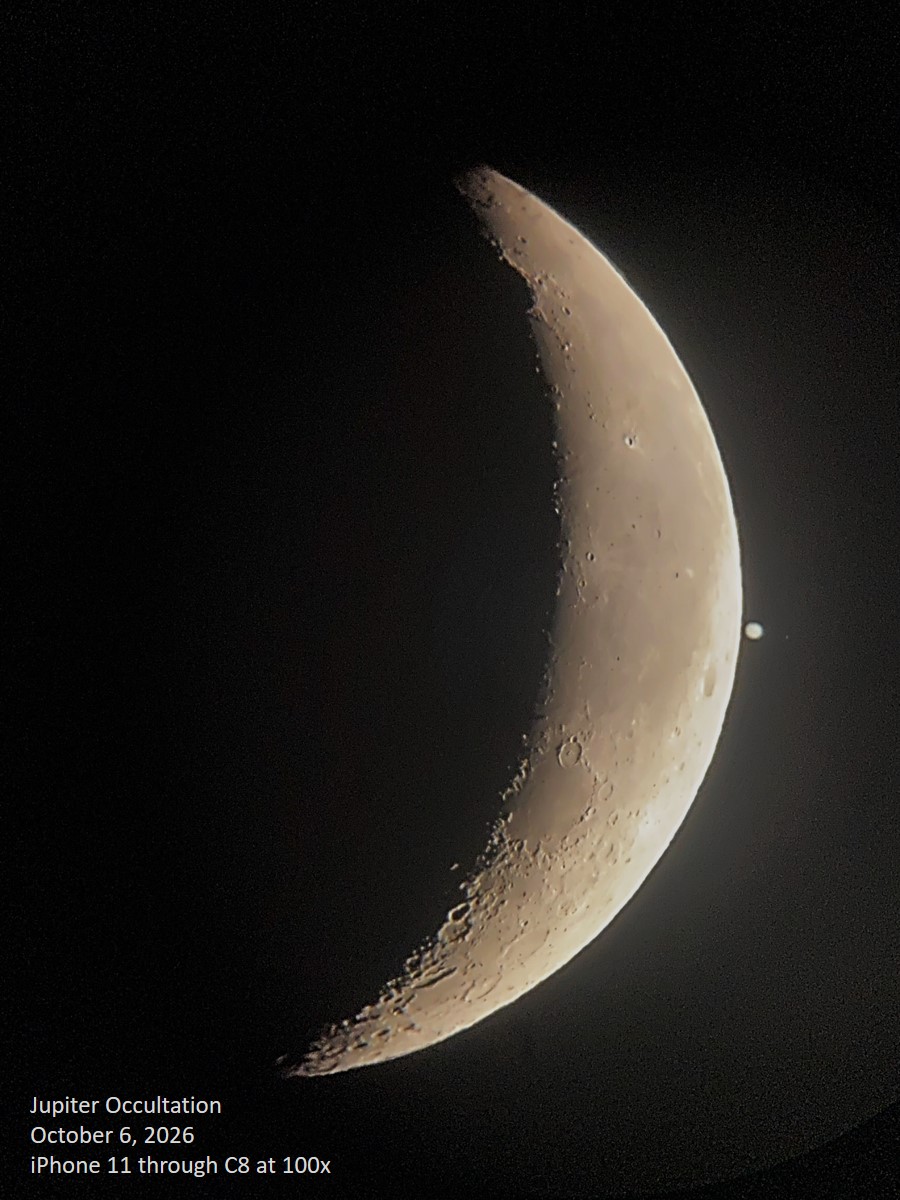
Eastern North America was treated to an excellent occultation of Jupiter by the Moon on the morning of
Tuesday, October 6, 2026. The entire event was visible for the eastern third of the United States and
up into Canada. For us in Virginia, the Moon first covered Jupiter around 4:19 a.m. when the pair was
about 15° up in the east. The occultation concluded at 5:24 a.m. as Jupiter reappeared from behind the
western limb of the Moon. At that time, they were about 32° high in the southeast.
My setup for observing and imaging the event was (1) a Celestron C8 with 20 mm Erfle eyepiece yielding
100x, through which I intended to observe as well as obtain afocal images with my iPhone 11, and (2) a
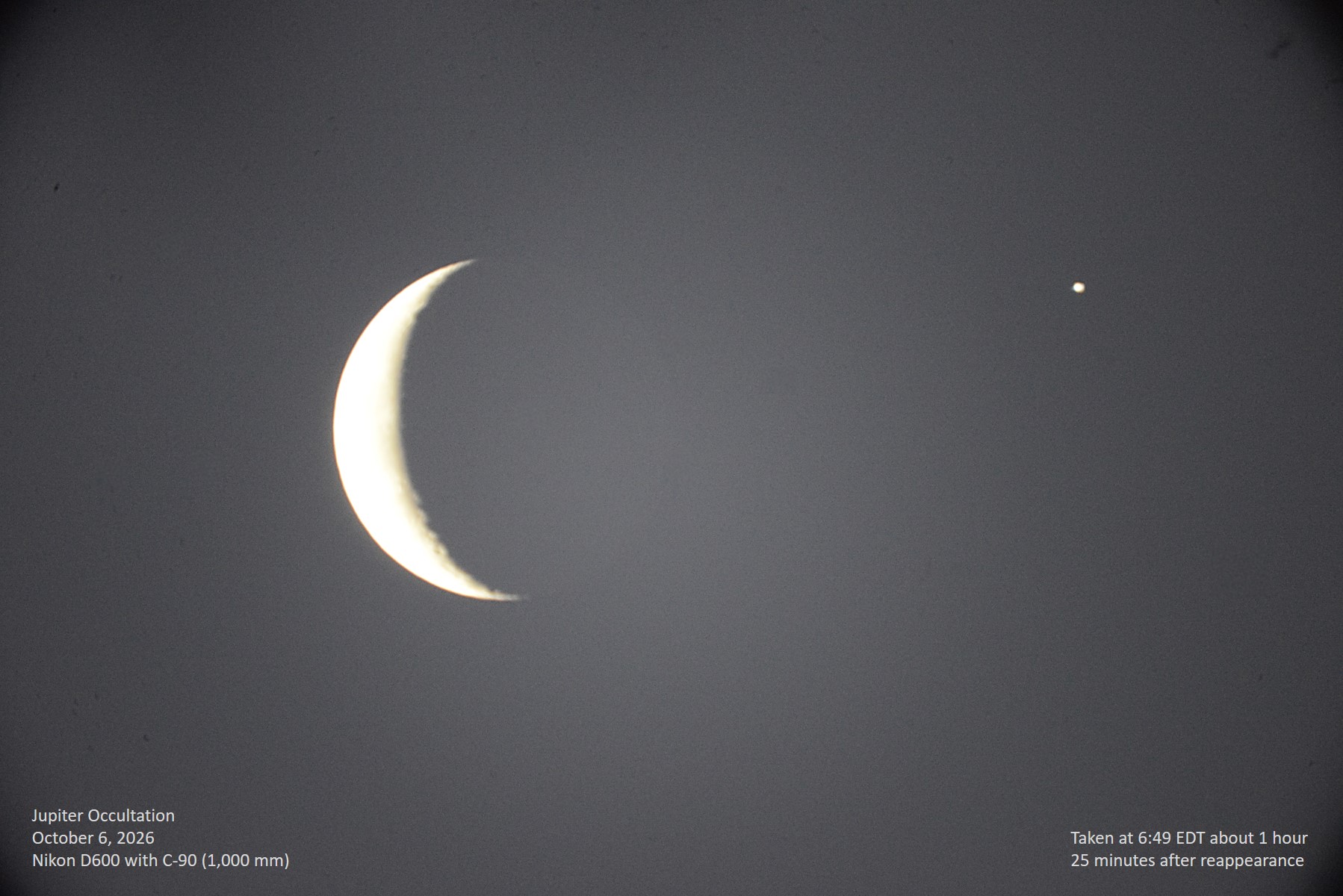
tracking mount with a Nikon D600 and Nikkor 400 mm lens. I also got several pictures after Jupiter re-
emerged with a 200 mm zoom lens and, during bright twilight, the Nikon paired with a legacy C-90 which
has a focal length of 1,000 mm.
Acquiring images using the afocal method (camera aimed at the telescope eyepiece) is challenging owing
to the difficulty that the phone has in determining how to expose the shot. When I used this method in
2025 to get pictures of the lunar occultation of Mars, the Moon was nearly full, so the eyepiece field
of view was uniformly bright, which enabled my iPhone to focus correctly on the scene. For this event,
however, the Moon was a crescent and I therefore discovered that my iPhone had a harder time focusing.
Only about half of the pictures were focused well enough to be usable. Nevertheless, in the first two
pictures in the right column, the Gallilean moons can be seen, and what is most interesting is that in
the time between the first and second pictures, it's clear that Callisto and Io, which are immediately
to Jupiter's left, have separated noticeably. Ganymede is the satellite to Jupiter's right and Europa
is closest to the Moon.
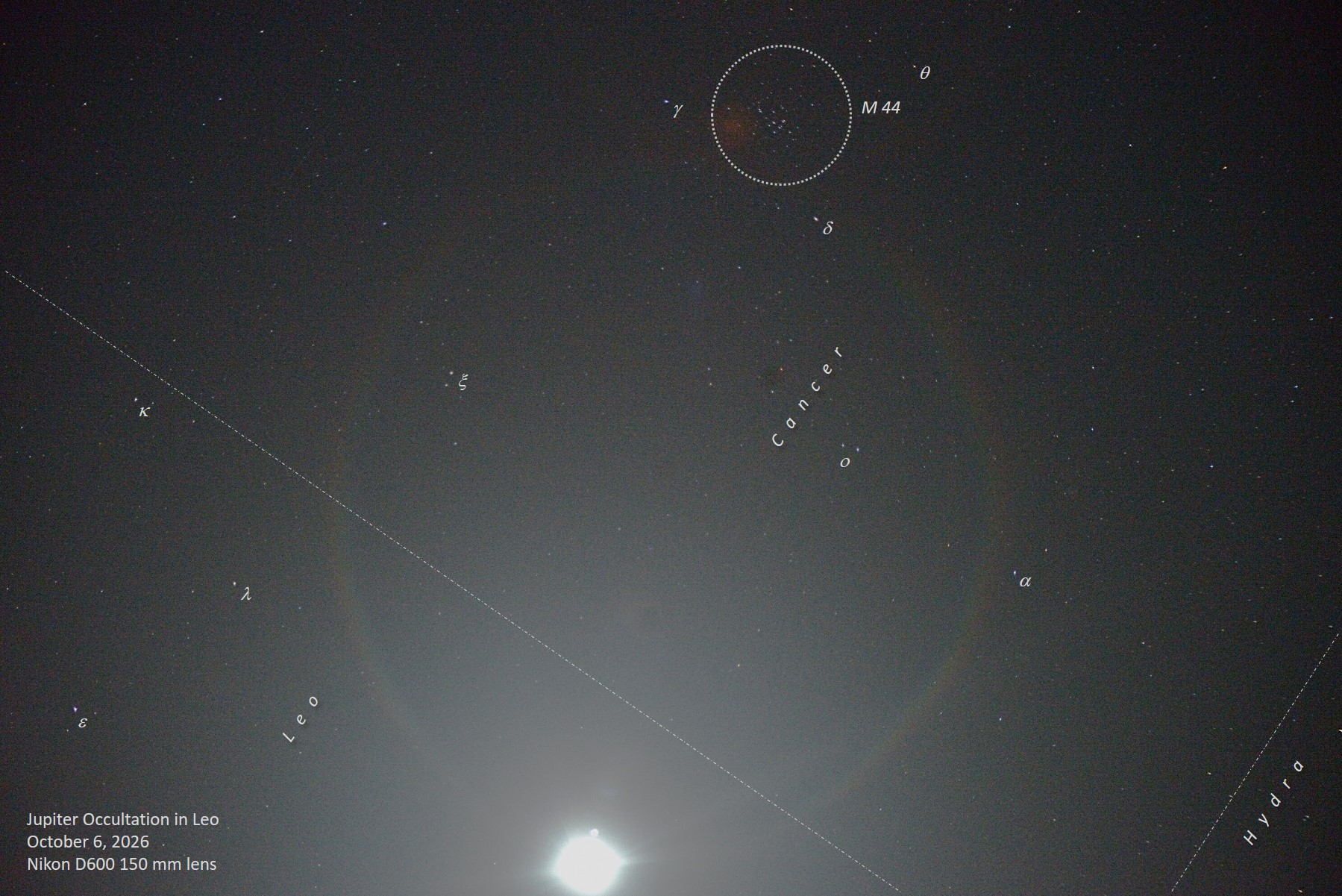
The occultation occurred with Jupiter and the Moon on the Leo side of the border separating Cancer and
Leo. The last image in the right column places the Jupiter-Moon pair in context with nearby
stars in Leo and Cancer, and with the Beehive Cluster, Messier 44, above it.