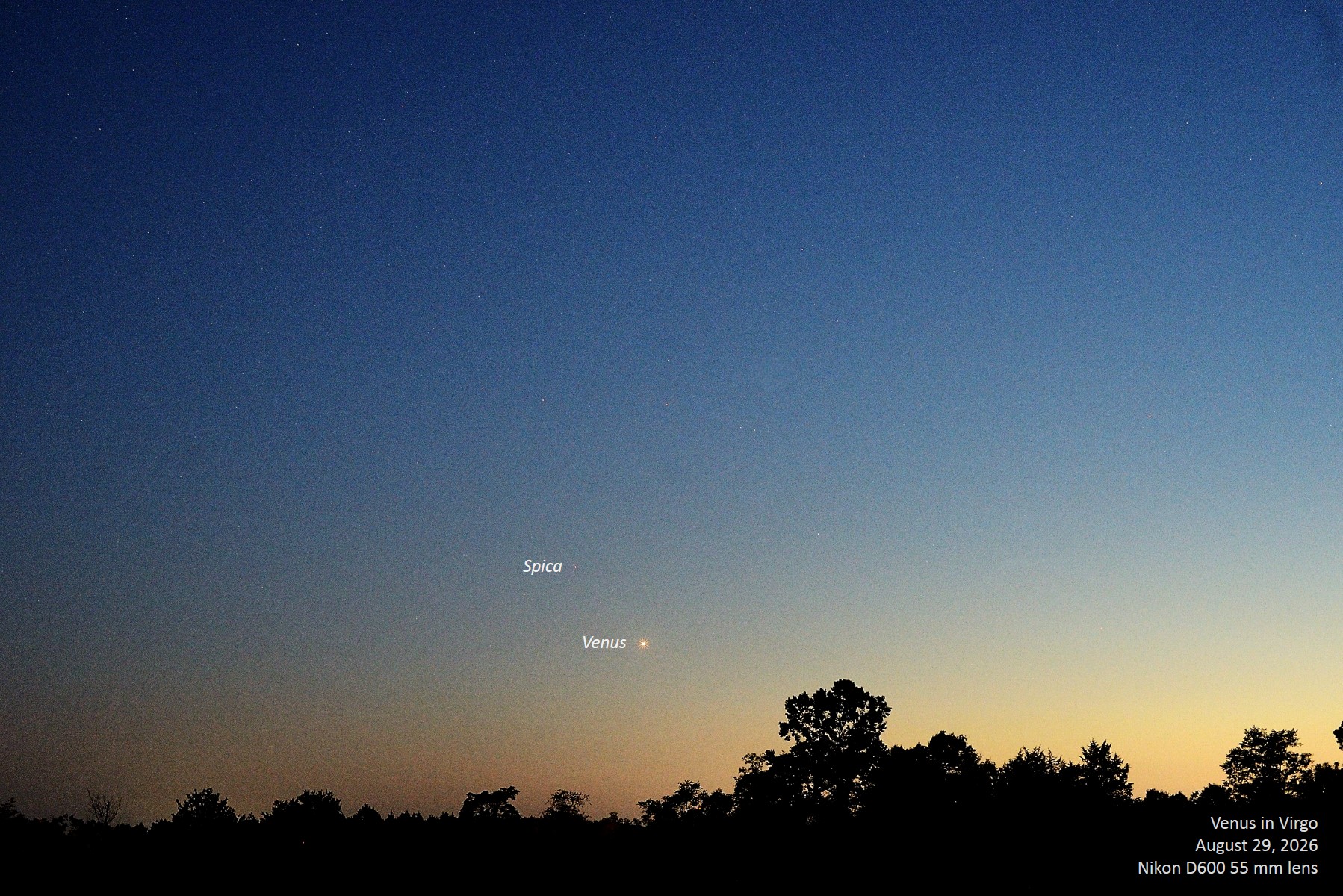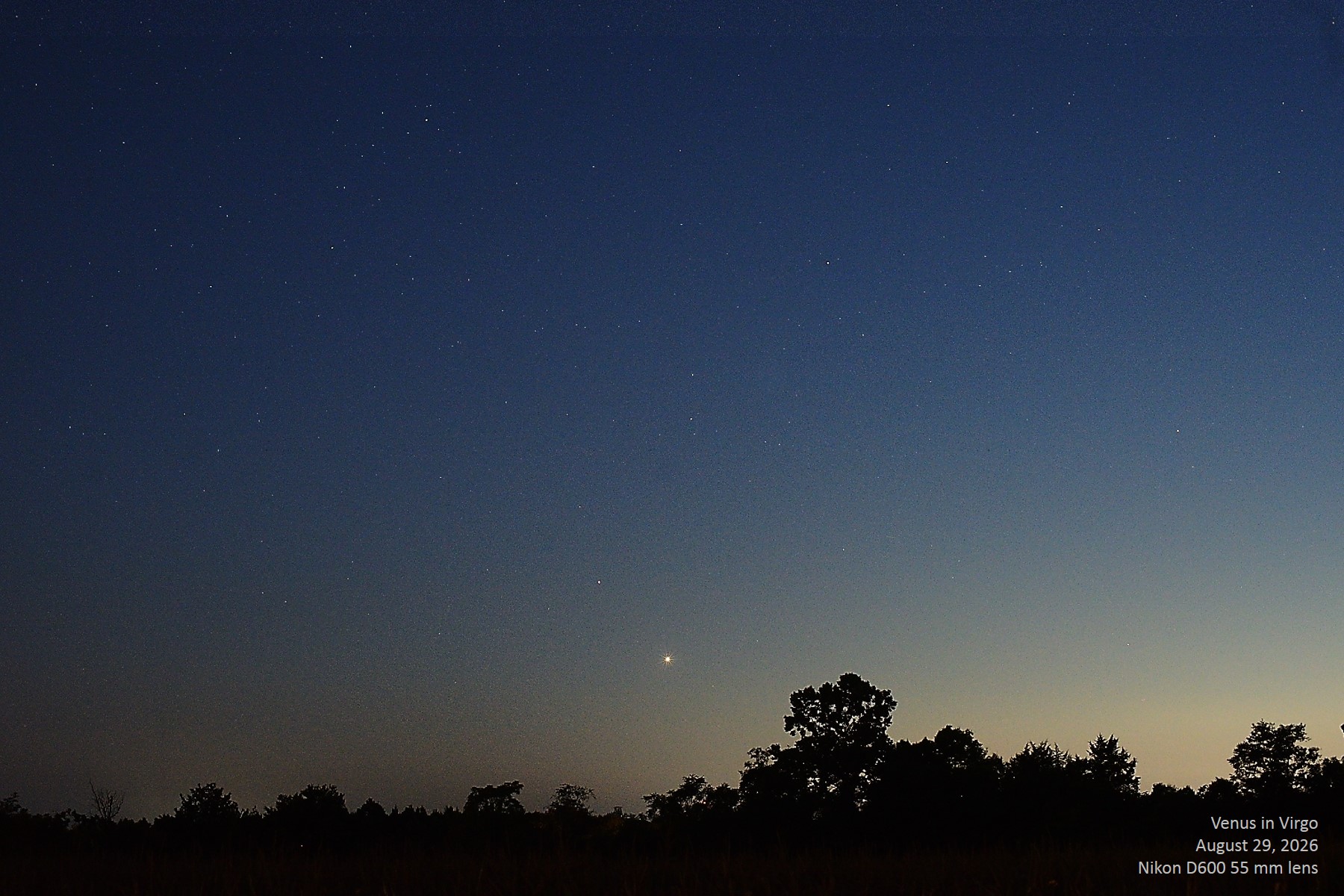
The brightest planet is sinking lower into the sunset each evening because it is now losing elongation from the Sun and because it is angling south away from the ecliptic each day. Here we see Venus only a few days away from its rendezvous with Spica, which will occur on September 1. Venus is quite bright this evening, shining at magnitude -4.44, but being so low in the sky, and factoring in the hazy conditions, it doesn't appear to blaze forth in the way that it often does. Unannotated image.
Venus' apparition this year is almost identical to that of 2018, 2010, 2002, 1994, and 1986. During these kinds of appearances, Venus' evening show ends with a late October or early November inferior conjunction in Libra by pass- ing well to the south of the Sun.
The October inferior conjunctions see Venus farthest south of the Sun as it passes between Earth and Sun. Despite this, our weather in late October can be good enough in Virginia that Venus can be seen with binoculars or a tele- scope on the date of inferior conjunc- tion.
Venus is already fairly far below the ecliptic on this date (3° 8' south of the Earth's orbital plane). She will continue to drift even farther south, passing 1° 29' underneath Spica three days from now. Because of its extreme southern tilt at the end of this kind of apparition, observers in the south- ern hemisphere have an excellent view of the inferior conjunction, for them very similar to northern hemisphere's view of Venus' late March passages in between Earth and Sun.
We will have to see how late into the apparition I will be able to observe, and get pictures of, Venus, because I have never managed one during October of one of these years.
A view from earlier in the evening: