Comet C/2025 A6 (Lemmon)
October 22, 2025
|
Comet C/2025 A6 (Lemmon) has put on a very nice show for observers in the northern
hemisphere over the past month or so. It reached its closest point to the Earth
on October 21, 2025 (yesterday) and will reach perihelion on November 8. Its
track brought the comet from the area of Gemini in between Castor and Pollux, through
Lynx and southern Ursa Major, then through the middle of Canes Venatici, and at this
point, across central Boötes near the star Izar or Pulcherrima. From here
it will continue across Serpens (Caput) and into central Ophiuchus.
I drove to the Blue Ridge Mountains and set up on the highest point at Big Spy Mountain
Overlook on the Blue Ridge Parkway, which is near mile marker 26, just north of the
crossing point where route 56 crosses the Parkway at the Tye River Gap. The comet
was barely visible to the unaided eye but great in 10x50 and 20x80 binoculars. I
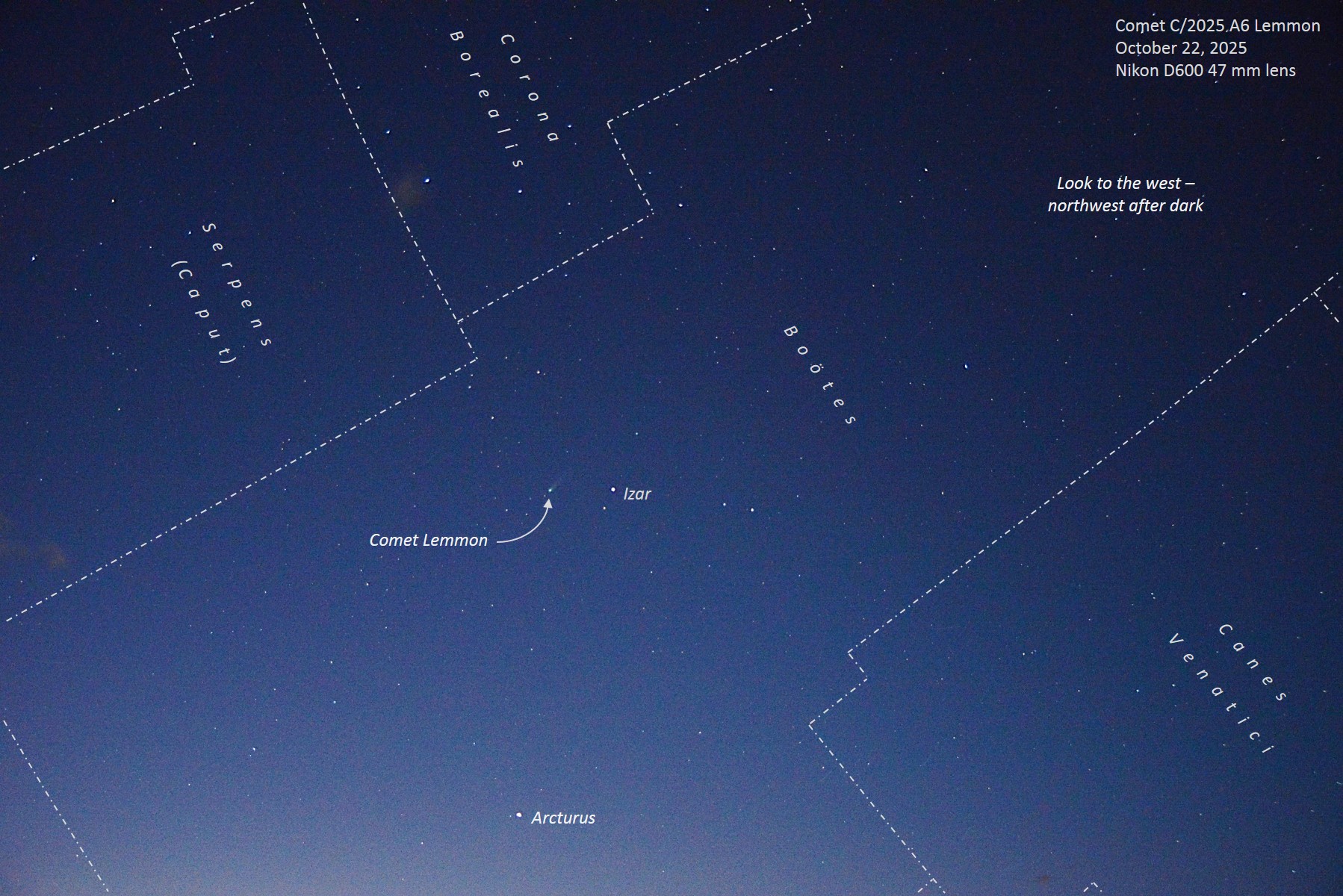
imaged the comet with a zoom lens set to just less than a standard focal length to get
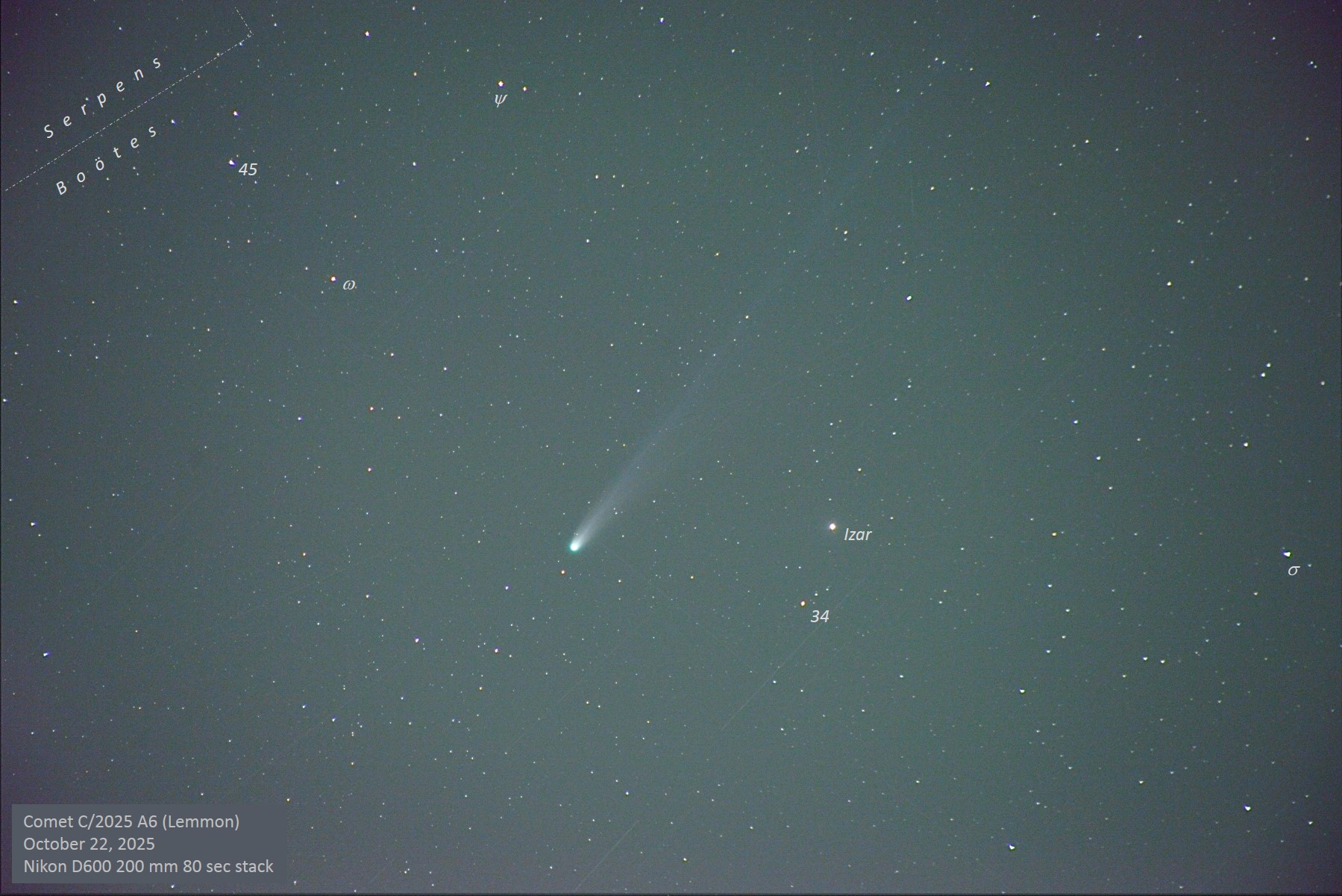
a shot that could be used as a finder chart over the next several days, and also at 200
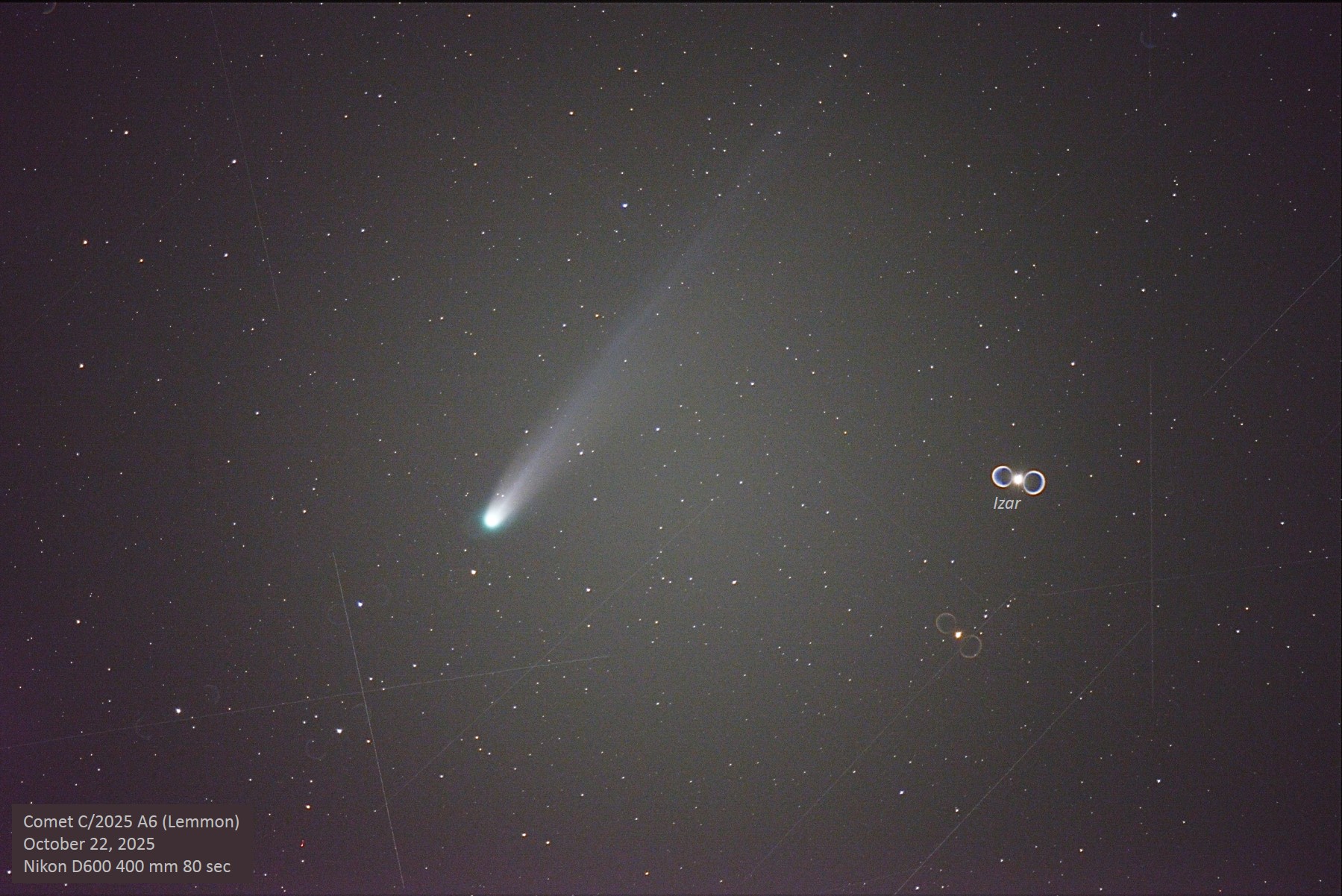
mm. I then switched to a 400 mm lens for a 30 second close-up which turned out
surprisingly well.
In the telephoto images, we see the bright thin line in the center of the tail that
distinguishes this comet from other recent comets (e.g., Comet NEOWISE in 2020 and
Tsuchinshan-ATLAS in 2024 did not exhibit that feature, at least on images that I
acquired). The inner (sunward) edge of the coma shows that bright green color
from diatomic carbon that many comets do. On this evening, the comet was easy
to locate because it was so close to the great double star Izar, otherwise known as
ε Boötis. I could not detect any evidence of an anti-tail,
which suggests that our viewing geometry is not in line with the comet's orbital
plane.
|
| |
The first image is the wide angle view at 47 mm focal length, the middle image is with
the zoom lens set to 200 mm, and the right-most image was acquired with a 400 mm mirror
lens operating at f/5.6. The 200 and 400 mm images are both the result of stacking
eight 10-second exposures. In them, you can
begin to see the differentiation in the gas and dust tails ~ the gas tail is at the upper
edge of the tail structure, while the dust tail is wider and curves slightly lower away
from the gas or ion tail. Based on the 200 mm image, it appears that the gas/ion
tail is at least 5° long. It extends up to the top of my image, so who knows
how much longer it is beyond that. As for the crazy artifacts on the 400 mm stack,
I unfortunately couldn't edit those bipolar loops out, nor the many satellite trails.
|