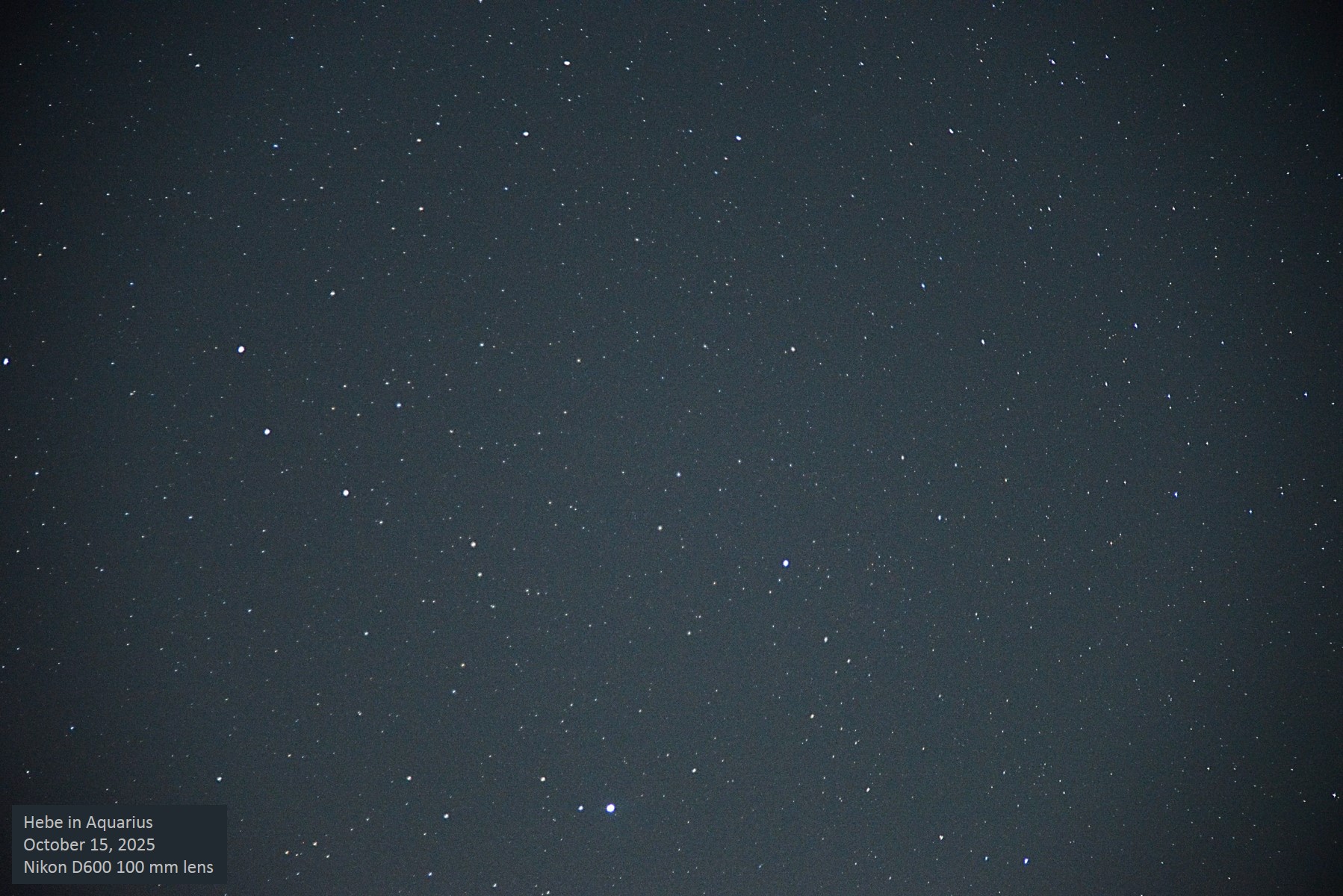
The asteroid 6 Hebe is interesting in several respects. By its designation,
we see that it was the 6th asteroid discovered, in 1847 by Karl Ludwig
Hencke of Brandenburg, Prussia. He also discovered 5 Astraea, however
those two were his only asteroid discoveries. The name "Hebe" was suggested
by none other than Karl Friedrich Gauss, the mathematician, upon being asked by
Hencke for a suitable name. Hebe is the Greek goddess of youth.
Hebe is high on the list of asteroids by mass but not by
volume, which indicates that it has a higher than average
density. The implication is that Hebe has a very solid
body when compared to most other asteroids of its size.
Despite its solid composition, astronomers believe that
Hebe is likely the source of meteorites identified as H
chondrites, which represent 40% of all meteorite impacts on Earth.
The asteroid also exhibits extreme characteristics in terms of its shape
and major surface features. It has a diameter of approximately 193 kilometers
(or at least it would if its body was sphere-ized), but apparently shows five large
crater or depression features that range from 50 km to 100 km in diameter, and with
depths of up to 18 kilometers. That's pretty extreme!
The minor planet, or asteroid, 6 Hebe is now several months after its opposition in August and now near the point where it has just ended retrograde motion and resuming eastward movement against the stars. It is located almost exactly on the border between Aquarius and Piscis Austrinus, however I believe it is on the Aquarius side of that line. Hebe is magnitude 8.7 this evening. Its motion beyond this point will carry it deeper into Aquarius. Unannotated image.