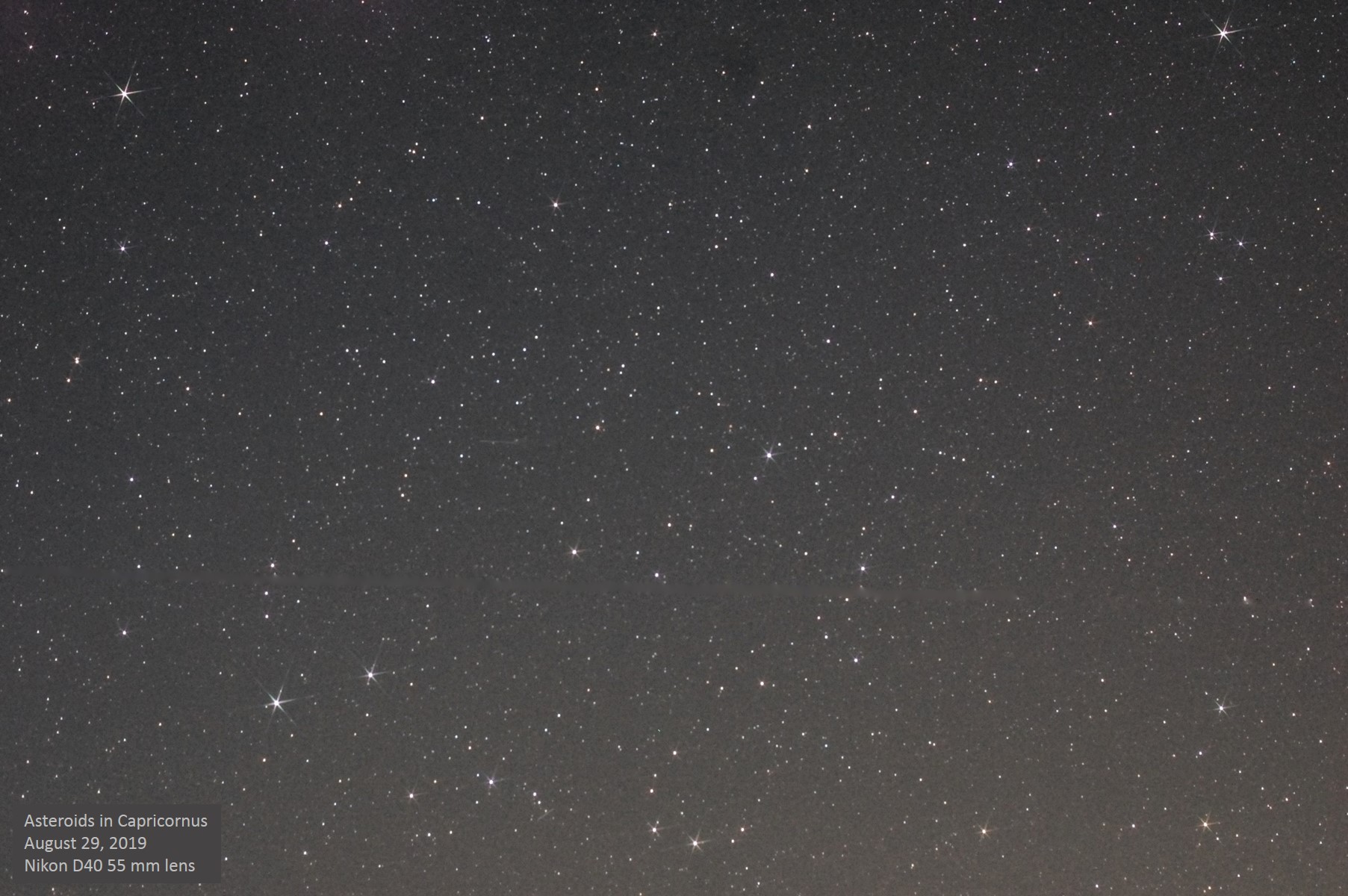
This part of the sky, despite not being near
the Milky Way, still has several interesting
objects. In Aquarius we have two dim Messier
objects, the globular cluster M72 and one of
Messier's "mistakes", the star group that he
labeled M73 and mistook it for a cluster. We
also have the fascinating NGC 7009, known as
the Saturn Nebula. This object is one of the
class of objects known as a planetary nebula
because of the appearance in the eyepiece to
William Herschel (appearing to be similar to
the planet Uranus, which he discovered).
Laetitia was at opposition on August 17, and
is thus still retrograding on this date. The
magnitude of Laetitia is in the range of 9.5
to 10.0. Psyche was at opposition on August 7
and is therefore also still in retrograde in
western Capricornus. The 16th asteroid to be
discovered, Psyche has been the subject of a
great amount of research because of its high
metallicity ~ potentially significant in the
area of asteroid mining but also in terms of
the formation of Earth and other terrestrial
planets in the early solar system.
M72 and M73 are infamous to participants in
the springtime amateur astronomy event that
is known as a Messier Marathon. The goal is
to observe all 110 Messier objects during a
single night, which can theoretically occur
only in late March or early April. The pair
of Aquarian objects rise shortly before the
morning twilight and as such can be highly
challenging to observe.
The Saturn Nebula is known for its blue and
green or aqua coloration, unless the imager
uses a false color palette. What is amazing
about this image is that my camera was able
to actually record this color!
Here we are looking at the constellation Capricornus at a time when there are two faint asteroids within its boundaries. Laetitia and Psyche are always quite faint and this is no exception, even though they are both near opposition at the time of my picture. This image was acquired with my Nikon D40 and a 55 mm lens, which yields an equivalent focal length of 85 mm if this picture had been taken with a full frame camera. Unannotated image.